Lombard Castle in Piazza Castello
The ruins of Avellino's Lombard castle hold a curious architectural puzzle.
Full story unlocks in the tour
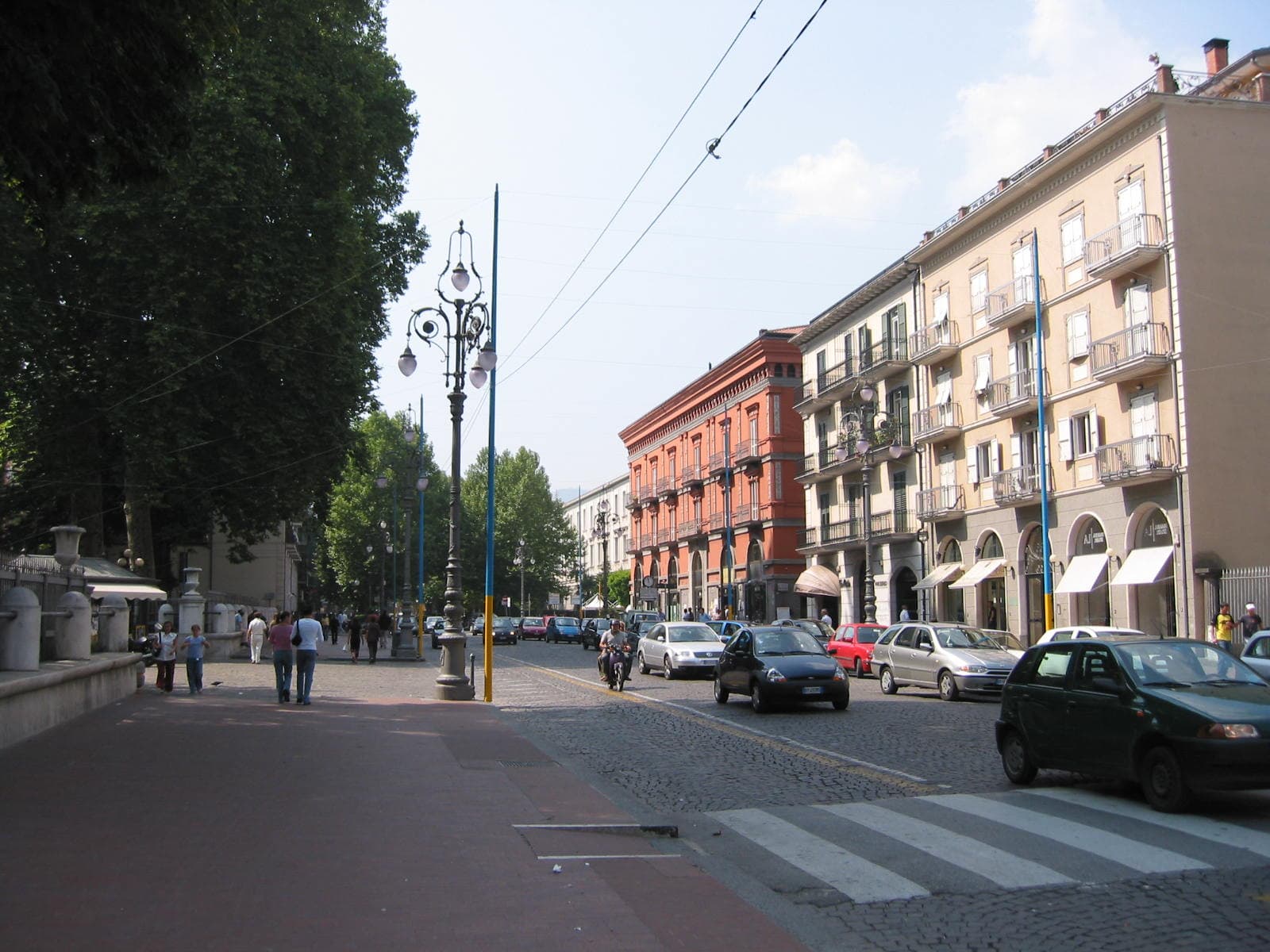 Unknown author / CC BY-SA 3.0, via Wikimedia Commons
“Avellino: A city shaped by resilience, where ancient echoes meet modern life in the heart of Irpinia.”
Not the postcards. The stories even locals don't know — whispered in your ear, right where they happened.
The ruins of Avellino's Lombard castle hold a curious architectural puzzle.
This Baroque landmark, visible from nearly every corner of Avellino, has a surprising history of repeated rebirths.
Avellino's roots stretch back to a Roman city, but you won't find its remains within the modern city center.
Discover every secret of Avellino
Every address, every reveal in full — in your ear, right where it happened.
You pick your stops. You walk. The voice reveals what the others miss.
No tours available yet. Check back soon — we're preparing them.
Avellino, the capital of its province in Italy's Campania region, is a city with a layered past, cradled amidst the Apennine mountains and the Sabato River valley. While it serves as an important hub connecting Salerno and Benevento, its character is often described as a blend of a mountain town and a regional administrative center. The city's history has been profoundly shaped by seismic activity and wartime events, leading to a landscape where modern structures stand alongside remnants of earlier eras.
Despite a history of rebuilding, Avellino offers a genuine Campanian experience, particularly for those interested in local food and wine culture. It's a place where you can explore historical sites, enjoy expansive mountain views, and delve into the authentic traditions of the Irpinia region. The area is particularly known for its vineyards, producing renowned wines like Taurasi and Fiano di Avellino, and its Montella chestnuts.
Avellino is often considered a quieter alternative to the bustling coastal cities, providing a gateway to the broader Irpinia region with its charming medieval villages and natural parks. It's a destination that invites a deeper look beyond its contemporary facade, revealing a resilient spirit and a profound cultural identity.
## From Samnite Stronghold to Roman Colony Avellino's origins trace back to the ancient Samnite Hirpini people, an Oscan-speaking tribe whose name, 'Hirpus,' means 'wolf.' Their stronghold, Abellinum, was located on the Civita hill, approximately 4 kilometers (2.5 miles) from the modern city, in what is now Atripalda. The Romans conquered Abellinum in 293 BC during the Samnite Wars. It underwent several name changes under Roman rule, including Veneria, Livia, Augusta, Alexandriana, and Abellinatium. A true Roman town was established after Lucius Cornelius Sulla's conquest in 89 BC, with the colony of Veneria Abellinatium founded on the left bank of the Sabato River. This new city featured massive walls and an orthogonal urban layout. Abellinum saw significant development during the Augustan age with the construction of the Serino aqueduct, and later became an episcopal seat around 500 AD.
## The Lombard Era and Feudal Lords Following the Lombard conquest of southern Italy in 568 AD, the ancient Roman city of Abellinum was abandoned, either partly or completely. A new settlement emerged on the Terra hill, forming the nucleus of modern Avellino. Defended by a castle, it became part of the Duchy, and later Principality, of Benevento, and subsequently the Principality of Salerno. In 1100, under Norman rule, Riccardo dell'Aquila acquired the city. Over the centuries, Avellino passed through the hands of various powerful families, including the Montfort, Del Balzo, and Filangieri. In 1581, Don Marino I Caracciolo purchased the feudal rights and was made Prince of Avellino in 1589, establishing the city as the main seat of the Caracciolo family.
## Earthquakes, Wars, and Modern Resilience Avellino has a long history of seismic activity. The city was severely impacted by earthquakes in 346 AD and again in 1688 and 1694, leading to significant rebuilding efforts, including the almost total reconstruction of the Clock Tower. In the 19th century, Avellino was a center of revolutionary movements, playing a role in the brigand riots of 1820 and forcing King Ferdinand I to recognize a constitution. However, the Unification of Italy did not initially bring significant benefits to the city, as it was cut off from major railway lines and far from the sea. The 20th century brought further hardship; Avellino was heavily bombed by Allied planes in 1943 during World War II, resulting in considerable loss of life and destruction. The city was rebuilt, only to be struck by another devastating earthquake on November 23, 1980, which measured 6.9 on the moment magnitude scale and caused widespread destruction, killing nearly 3,000 people and leaving 300,000 homeless across the Irpinia region. Despite these challenges, Avellino has consistently rebuilt and adapted, maintaining its identity as an important administrative and agricultural center.
Begin your exploration at the Duomo di Avellino, a 12th-century Romanesque cathedral dedicated to the Assumption of Mary and Saint Modestinus. While its facade was redone in a neoclassical style in 1891, its Romanesque crypt has retained its original appearance, offering a striking architectural contrast. Nearby, the Clock Tower (Torre dell'Orologio), a Baroque monument from the 17th century, stands as a prominent symbol of the city, its imposing height visible from many vantage points.
For a glimpse into the region's past, visit the Bourbon Prison (Carcere Borbonico), which now houses the Pinacoteca Provinciale art museum and the Museo Irpino, featuring archaeological and historical collections from across Irpinia. Stroll along Corso Vittorio Emanuele II, Avellino's main pedestrian boulevard, lined with shops and cafes, a central gathering place for locals. While the original Lombard Castle has only a few ruins remaining in Piazza Castello, the nearby Casina del Principe, a restored 16th-century Caracciolo palace, is used for events. Don't miss the 17th-century Fountain of Bellerophon (Fontana di Bellerofonte), also known as the Fountain of the Three Cannuoli, a Baroque landmark.
Beyond the city center, consider a trip to the Sanctuary of Montevergine in Mercogliano. This Benedictine abbey, founded in 1119, is a significant pilgrimage site accessible by funicular or car, offering expansive views of Avellino.
Avellino is enjoyable throughout much of the year, with spring and autumn generally considered the best times to visit for pleasant temperatures ideal for outdoor activities and exploring historical sites. Specifically, mid-April to mid-June and September to early October offer comfortable conditions. Summers, from June to August, are warm and sunny, with average daily temperatures between 65°F and 80°F, making it suitable for hot-weather activities, especially from early July to late August. Winters are mild and can be a good time to visit without the larger crowds. The city also hosts traditional markets and celebrations during Christmas and Carnival, and the Feast of the Assumption on August 15th.
Avellino is situated approximately 47 kilometers (29 miles) east of Naples, making it accessible for day trips from the regional capital. The city is well-connected by road, facilitating exploration of the surrounding Irpinia region. While Avellino itself is not a major tourist destination, it serves as a convenient base for discovering nearby historic villages, natural parks, and culinary experiences.
For accommodation, Avellino and its surrounding areas offer various options, including agriturismo resorts, which provide a unique farmhouse stay experience. The local cuisine is a highlight, featuring pasta dishes, Montella chestnuts, and renowned wines like Taurasi and Fiano di Avellino. Don't miss the Benedictine herbal liqueur, a traditional local digestivo. The currency used is the Euro (€).