Moliceiro Boats
The colorful moliceiro boats navigating Aveiro's canals once served a purpose beyond scenic tours.
Full story unlocks in the tour
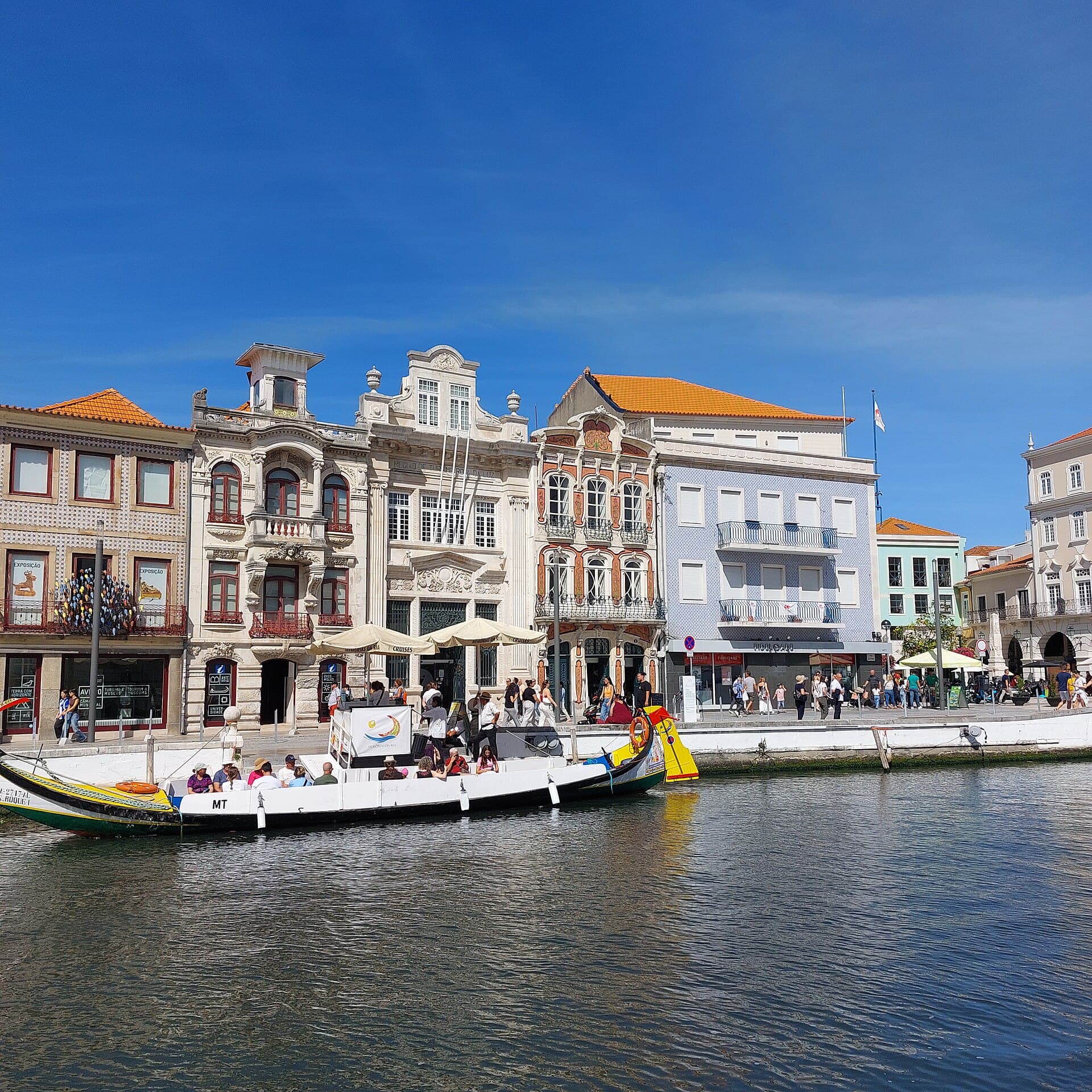 Threeohsix / CC BY-SA 4.0, via Wikimedia Commons
“Canals, salt, and Art Nouveau: Aveiro, where tradition flows with modernity.”
Not the postcards. The stories even locals don't know — whispered in your ear, right where they happened.
The colorful moliceiro boats navigating Aveiro's canals once served a purpose beyond scenic tours.
Beyond its functional role, the old Aveiro Train Station holds an unexpected artistic secret.
Aveiro's renowned 'ovos moles' trace their origins to royalty and convents, but their widespread popularity was secured in a rather public setting.
Discover every secret of Aveiro
Every address, every reveal in full — in your ear, right where it happened.
You pick your stops. You walk. The voice reveals what the others miss.
No tours available yet. Check back soon — we're preparing them.
Aveiro, often likened to the 'Venice of Portugal,' is an enchanting city where waterways interlace with a rich past, striking Art Nouveau architecture, and a flourishing contemporary spirit. Situated on the Silver Coast, between Porto and Coimbra, Aveiro offers a distinct allure rooted in its singular lagoon system, the Ria de Aveiro. The city's identity is deeply connected to its canals, where brightly painted moliceiro boats, once used for harvesting seaweed, now provide leisurely excursions, offering a unique perspective of the city's picturesque beauty.
Beyond the appealing canals, Aveiro presents a graceful blend of tradition and modernity. From its historic salt pans, still in operation today, to its elegant Art Nouveau buildings, the city invites exploration at a relaxed pace. Aveiro is a city easily traversed on foot, with most attractions within easy reach, making it ideal for those who delight in strolling and discovering local culture. It is a place where the scent of the sea mingles with the sweet aroma of local pastries, and where every corner reveals a narrative of endurance and cultural richness.
The history of Aveiro extends to antiquity, with evidence of Roman presence and its earliest documented mention in 959 AD under the Latin name Aviarium, meaning 'place where birds live' or 'aviary'. From its beginnings, Aveiro's development was profoundly linked to its geographical location and abundant natural resources, particularly salt production. Salt from Aveiro was highly prized and exported across Portugal and Europe, becoming a significant source of wealth.
By the 15th century, Aveiro had grown into a prosperous city, fortified with walls and supporting a major fishing fleet and extensive sea trade. A pivotal moment in its history arrived in 1472 when Princess Joan, daughter of King Afonso V, entered the Monastery of Jesus, elevating the city's political and religious standing. However, this prosperity was dramatically interrupted in 1575 when a powerful winter storm created a sandbank, obstructing the harbor mouth and forming the Ria de Aveiro lagoon. This natural disaster led to economic decline and a significant population decrease, as the stagnant lagoon fostered diseases.
The city's fortunes began to shift in the 19th century with the construction of a new canal system, which reconnected the lagoon to the ocean in 1808. This re-established Aveiro's maritime links and spurred a new era of dynamism. The early 20th century saw the emergence of Art Nouveau architecture, as Portuguese emigrants returning from Brazil invested their wealth in constructing elaborate mansions along the canals. This architectural style, characterized by graceful curved lines and intricate facades, is a distinguishing feature of Aveiro today, earning it a place in the Réseau Art Nouveau Network.
Today, Aveiro continues to evolve, merging its maritime heritage with the dynamism of a university city and a manufacturing center. Its history, shaped by both natural challenges and human ingenuity, has forged a city that is both deeply traditional and forward-looking, always maintaining its strong connection to the Ria and the sea.
Begin your exploration with a leisurely cruise on a moliceiro boat, gliding along the central canals to admire the city's unique architecture and learn about its past. Afterwards, wander through the historic center, where you will encounter a captivating mix of Art Nouveau buildings, particularly along Rua João Mendonça and Praça do Peixe. The Museu de Aveiro, housed in the former Mosteiro de Jesus, is a worthwhile visit, displaying religious art and the ornate tomb of Princess Saint Joana.
Be sure to see the old Aveiro Train Station, celebrated for its striking azulejo panels depicting regional scenes. For a glimpse of local life, visit the Mercado Manuel Firmino, a lively market, or the fish market in Praça do Peixe, especially in the mornings. A short bus ride or drive will take you to Costa Nova, an appealing fishing village known for its candy-striped houses, and the nearby Praia da Barra with its impressive lighthouse. Finally, no visit is complete without sampling the traditional ovos moles, a sweet egg yolk and sugar delicacy, available at various confectioneries like Confeitaria Peixinho.
The ideal time to visit Aveiro for agreeable weather and outdoor activities is from April to September. Spring (March to May) offers balanced weather with moderate sunshine and temperatures averaging 15-20°C, perfect for exploration. Summer (June to August) is warm and dry, with average highs around 25°C, though heatwaves can elevate temperatures further. Early autumn (September to October) still enjoys warm, dry days, feeling like a softer version of summer, with fewer crowds. While winter is cooler and quieter, with more rainfall, most attractions remain accessible.
Aveiro is conveniently located and easily accessible. It is well-connected by train from both Porto (approximately one hour) and Lisbon (around two and a half hours), making it an excellent day trip or a relaxed overnight stay. Once in Aveiro, the city is largely flat and compact, ideal for exploring on foot or by bicycle. Free BUGA bikes are available from designated stands, offering an economical way to navigate. While Portuguese is the official language, English is widely spoken in tourist areas. Most establishments accept card payments, and ATMs are readily available. If driving, parking can be found near the salt museum and the train station.