Astrakhan Kremlin
Beyond its formidable white walls, the Kremlin holds a secret that speaks to a darker chapter of its past.
Full story unlocks in the tour
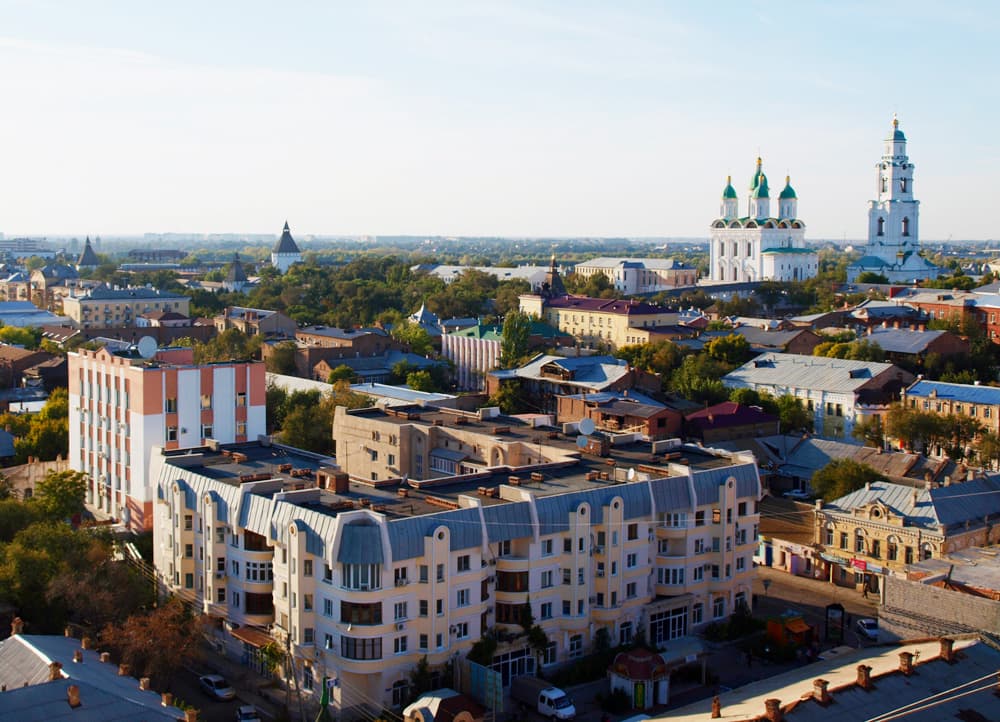 http://ic.pics.livejournal.com / CC BY-SA 4.0, via Wikimedia Commons
“Where the Volga meets the Caspian, a crossroads of continents.”
Not the postcards. The stories even locals don't know — whispered in your ear, right where they happened.
Beyond its formidable white walls, the Kremlin holds a secret that speaks to a darker chapter of its past.
The vast delta of the Volga River is not just a haven for wildlife; it harbors a surprising botanical spectacle that transforms the landscape annually.
Wandering the city's streets, you might notice architectural clues hinting at Astrakhan's historical role as a melting pot of cultures, far beyond just Russian influences.
Discover every secret of Astrakhan
Every address, every reveal in full — in your ear, right where it happened.
You pick your stops. You walk. The voice reveals what the others miss.
No tours available yet. Check back soon — we're preparing them.
Astrakhan, a city in southern Russia, sits at the mouth of the Volga River, where Europe's longest river empties into the Caspian Sea. Often called the "Caspian capital" and the "southernmost outpost of Russia," this historic city is a blend of Russian, Tatar, and Kazakh influences, reflected in its diverse architecture and cultural heritage. With a population of over half a million, Astrakhan is a lively hub known for its sturgeon, black caviar, and immense watermelons.
Spread across 11 islands within the Volga Delta, Astrakhan's landscape is characterized by numerous canals and bridges, earning it the moniker "Venice on the Volga." The city serves as a crucial transport hub, connecting Europe and Asia via the Caspian Sea and the Volga River routes, and is a key element of the North-South International Transport Corridor. Beyond its historical significance, Astrakhan offers a unique natural environment, with the Volga Delta being Europe's largest river delta and a significant area for fishing and eco-tourism.
Astrakhan's history stretches back to the 13th century, when it was known as Xacitarxan (Hajji Tarkhan) and served as one of the capitals of the Mongol Golden Horde. The city was a major trading center, connecting India, Persia, Russian principalities, and Europe. However, its early existence was marked by turmoil; Tamerlane burned it to the ground in 1395 during his war with the Golden Horde. From 1459 to 1556, the city was the capital of the Astrakhan Khanate, a Tatar state.
The modern city of Astrakhan began to take shape after Ivan the Terrible annexed the Astrakhan Khanate to Russia in 1556. In 1558, a new Russian fortress was founded on Zayachiy Bugor Hill, 12 kilometers from the old settlement, establishing Astrakhan as Russia's southern outpost. This fortress, the Astrakhan Kremlin, was built from the 1580s to the 1620s using bricks from the site of Sarai Berke. In the 1670s, Astrakhan was briefly captured by Cossack rebel Stepan Razin before returning to Russian control, becoming a launching point for forays into Central Asia and Persia.
Peter the Great further solidified Astrakhan's importance in 1717, making it the seat of the Astrakhan Governorate and establishing an admiralty and military port. The city flourished as a center of international trade, attracting merchants from Russia, Persia, India, and Central Asia, which contributed to its unique multicultural character. Despite challenges like fires, plunder by Safavid Persians, and a cholera outbreak in 1830, Astrakhan continued to grow, with spacious streets, cathedrals, and international trading centers being built. During World War II, the city was a key oil supplier and, despite being threatened by German forces, never fell into enemy hands. Today, Astrakhan remains a city with a rich cultural heritage, home to over 100 ethnic groups and various religious denominations.
The crowning beauty of Astrakhan is its white-stone Kremlin, a 16th-century fortress on Zayachiy Bugor Hill. Inside its walls, you'll find the magnificent emerald-domed Trinity Cathedral, the complex's oldest structure, and the 18th-century Assumption Cathedral, admired by Peter the Great. The bell tower of Prechistenskaya Gate, the tallest building in the Kremlin, offers sweeping city views.
Beyond the Kremlin, stroll along the Volga River Embankment, a lively pedestrian area with cafes, statues, and inviting bridges, offering views of the wide Volga. Explore the historic White City, where mosques and eastern merchant farmsteads are preserved. Nikolskaya Street, considered the city's most beautiful, connects the Kremlin to the waterfront and is lined with historic buildings. For a deeper dive into local culture, visit the Astrakhan City History Museum, which showcases centuries of local life, including a large stuffed beluga and sturgeon. The Sarai Batu cultural-historical center, an outdoor museum 140 km from Astrakhan, offers a recreated Golden Horde capital with ancient buildings and Mongolian yurts. Do not miss the "Russian Watermelon" Museum, dedicated to the region's iconic fruit.
The best time to visit Astrakhan is during the high season, from May to June and in September, when the weather is pleasant for sightseeing and outdoor activities. Temperatures during these months range from mild to warm, making it comfortable for exploring the city and the Volga Delta. Late July to mid-September is ideal for witnessing the blooming Caspian lotus fields in the delta. Summers (July-August) can be very hot and dry, with daily highs frequently reaching 33-35°C (91-95°F), which might limit daytime city exploration. Winters (November-March) are cold, with temperatures ranging from -5°C to 1°C (23-34°F) in December, offering snowy landscapes but shorter daylight hours and fewer tourist activities.
Astrakhan is generally safe for tourists, but it's wise to remain vigilant in crowded areas and protect personal belongings. The official currency is the Russian Ruble (RUB), with ATMs widely available and credit cards accepted at most hotels, restaurants, and shops. Tipping is appreciated. The primary language is Russian, though the region's diverse population means other languages like Kazakh and Tatar are also present.
Astrakhan International Airport (ASF), also known as Astrakhan Boris M. Kustodiev International Airport, serves the city with regular connections to Moscow and other major Russian cities. Public transport within the city includes buses and marshrutkas (shared taxis); taxis are also readily available, and it's advisable to negotiate fares beforehand. Car rentals are available at the airport and in the city center. Remember that a sharply continental climate means packing for extremes: lightweight clothing and insect repellent for summer, and thermal wear for winter.