Castle of Caterina Cornaro
This castle, once a grand Renaissance court, holds a secret about its most famous resident.
Full story unlocks in the tour
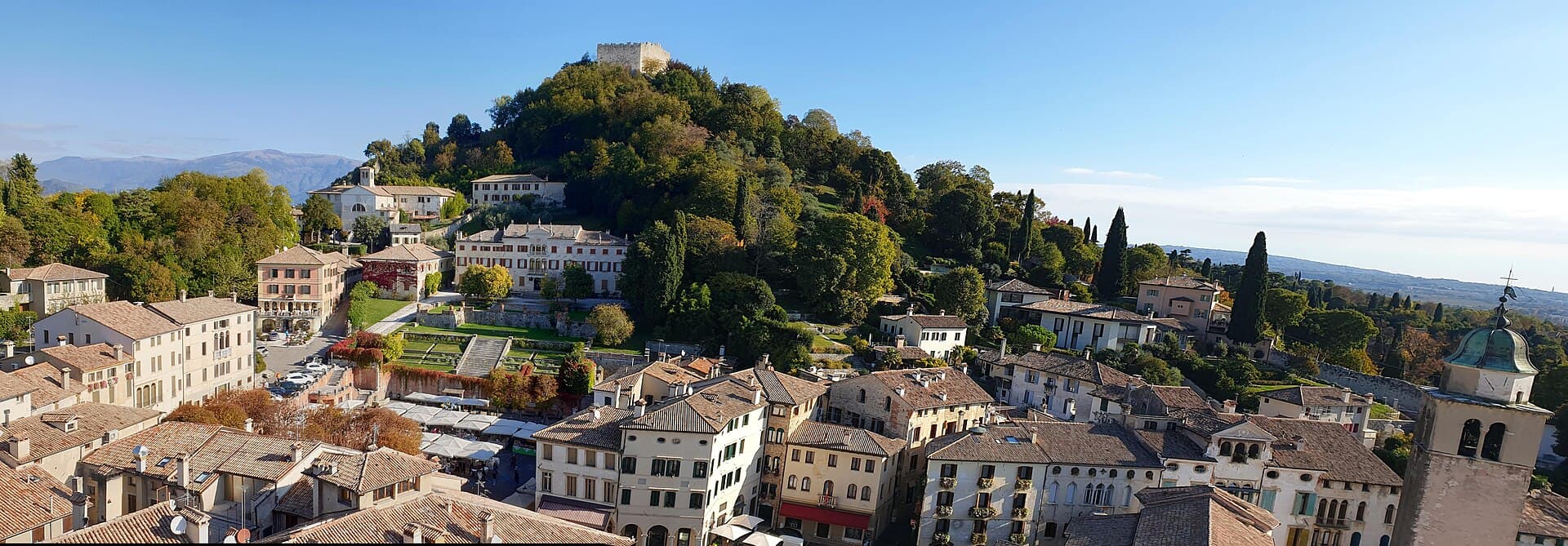 ModriDirkac / CC BY-SA 4.0, via Wikimedia Commons
“Where every vista tells a story, and history breathes in the quiet corners.”
Not the postcards. The stories even locals don't know — whispered in your ear, right where they happened.
This castle, once a grand Renaissance court, holds a secret about its most famous resident.
The home of a renowned explorer and writer, this villa played an unexpected role during wartime.
Observe the walls inside this historic tower, and you'll find a poignant reminder of its past.
Discover every secret of Asolo
Every address, every reveal in full — in your ear, right where it happened.
You pick your stops. You walk. The voice reveals what the others miss.
No tours available yet. Check back soon — we're preparing them.
Asolo, often called "The City of a Hundred Horizons" after a verse by Italian poet Giosuè Carducci, is a lovely town in the Veneto region of northern Italy. Situated atop one of the green hills of the Marca Trevigiana, about an hour from Venice, it offers a peaceful escape from busier destinations. The town is encircled by ancient walls that branch off from its 12th-century fortress, preserving a sense of its long history. Asolo is recognized as one of Italy's most beautiful villages, characterized by its faded frescoes, arcaded streets, and stone lanes.
This appealing locale has long drawn artists, writers, and intellectuals, including English poet Robert Browning, actress Eleonora Duse, and travel writer Freya Stark, all of whom found inspiration and a quiet retreat here. Its unhurried pace invites visitors to slow down, observe, and immerse themselves in its beauty. From its wide views of rolling hills and vineyards to its well-preserved historic center, Asolo provides a unique blend of cultural richness and serene ambiance.
## From Roman Acelum to Venetian Splendor Asolo's origins trace back to Roman times, when it was known as Acelum. Pliny the Elder mentioned it in 77 CE, indicating its importance as one of the largest colonies in the tenth Augustan region, Venetia et Histria. Archaeological findings, including remains of a spa, an aqueduct, a forum, and a theater, testify to its significance during the Roman era.
In the early Middle Ages, Asolo was a possession of the powerful Ezzelini family before eventually falling under the sway of Venice. Its period of greatest splendor began in 1337 when it was handed over to Venice and became a chief magistrate's office. Venice promoted the area's repopulation through tax relief.
## Caterina Cornaro's Renaissance Court A pivotal figure in Asolo's history was Caterina Cornaro, the former Queen of Cyprus. After being compelled by Venice to surrender her kingdom in 1489, she was granted the fiefdom of Asolo for life. From 1489 to 1509, Caterina established a magnificent Renaissance court in the castle that now bears her name, attracting artists, poets, and literati. It was during this time that Pietro Bembo set his famous dialogues on transcendent love, Gli Asolani, at her court.
## A Haven for Artists and Intellectuals After a decline in the 1600s, partly due to an earthquake in 1695, Asolo recovered and was officially recognized as a city in 1742. From the mid-1800s, it became a cherished destination for foreign travelers and intellectuals. English poet Robert Browning, who visited Italy for the first time in 1838, was deeply inspired by Asolo, using it as a backdrop for much of his work, including his last volume of poetry, Asolando, published on the day of his death in 1889. The main road into town, Via Browning, is named in his honor.
Eleonora Duse, a legendary Italian actress, also made Asolo her home in her later years, choosing to be buried in the cemetery of Sant'Anna, facing Monte Grappa, out of love for Italy and the soldiers she aided during World War I. The British explorer and travel writer Freya Stark, who lived to be 100, also spent much of her childhood and later life in Asolo, finding it a safe haven between her extensive travels. Her home, Villa Freya, is a notable site.
Asolo's compact historic center is ideal for leisurely exploration on foot. Begin at Piazza Garibaldi, the town's main square, where you can admire the 16th-century Fontana Maggiore, topped with a Venetian lion. From here, narrow, stone lanes lead to many of Asolo's key sights.
The Castle of Caterina Cornaro, dating back to the 10th century, stands prominently in the heart of the historic center. Once a royal residence and later a prison, it now houses the Eleonora Duse Theater and the Civic Museum, which displays archaeological finds, paintings, and historical documents. The Civic Tower, or Clock Tower, offers wide views of the town and surrounding hills.
Ascend to the Rocca di Asolo, a 12th-century polygonal fortress atop Monte Ricco, for sweeping 360-degree vistas of the landscape. While the interior of the fortress is largely unadorned, the climb is rewarded by the expansive views. Back in town, the Duomo di Santa Maria Assunta (Cathedral of Santa Maria Assunta), first mentioned in 969, features a neoclassical façade and houses significant artworks, including an altarpiece by Lorenzo Lotto.
For a glimpse into Asolo's Roman past, visit Piazza Brugnoli to see the remains of the ancient Roman aqueduct, "La Bot," which once supplied water to Roman baths. Nearby, Villa Freya, the former home of Freya Stark, is set within a beautiful garden. The Civic Museum, located in the Palazzo della Ragione, offers further insights into local history and culture, with a dedicated section to famous residents like Robert Browning, Freya Stark, and Eleonora Duse.
Asolo enjoys pleasant weather from May to September, making these months ideal for sightseeing and outdoor activities. July is typically the warmest month, with average highs around 29°C (84°F) and lows around 18°C (65°F), offering ample sunshine. For those seeking to enjoy the expansive vistas, the period between July and September is particularly recommended. Autumn, especially September, also provides a beautiful landscape and pleasant temperatures for exploring the vineyards. While November is the wettest month, January is the driest and coldest, with average highs of 7°C (45°F) and lows of -1°C (30°F).
Asolo is approximately one hour by car from Venice, making it a viable day trip or a longer, more relaxed stay. The town's historic center is largely pedestrianized, so plan to park on the outskirts and explore on foot. The climb to the Rocca can be steep but is well worth the effort for the views. The local cuisine is a highlight, with opportunities to enjoy authentic pasta and pastries. Don't miss sampling the Asolo Prosecco Superiore DOCG, a sparkling wine unique to this region. Many local wineries offer tours and tastings. The Civic Museum and some other attractions may have limited opening hours, often open on weekends, so it's advisable to check in advance.