Bab Homar Gate
Beyond its impressive stone archway, this gate holds a curious detail from a bygone era.
Full story unlocks in the tour
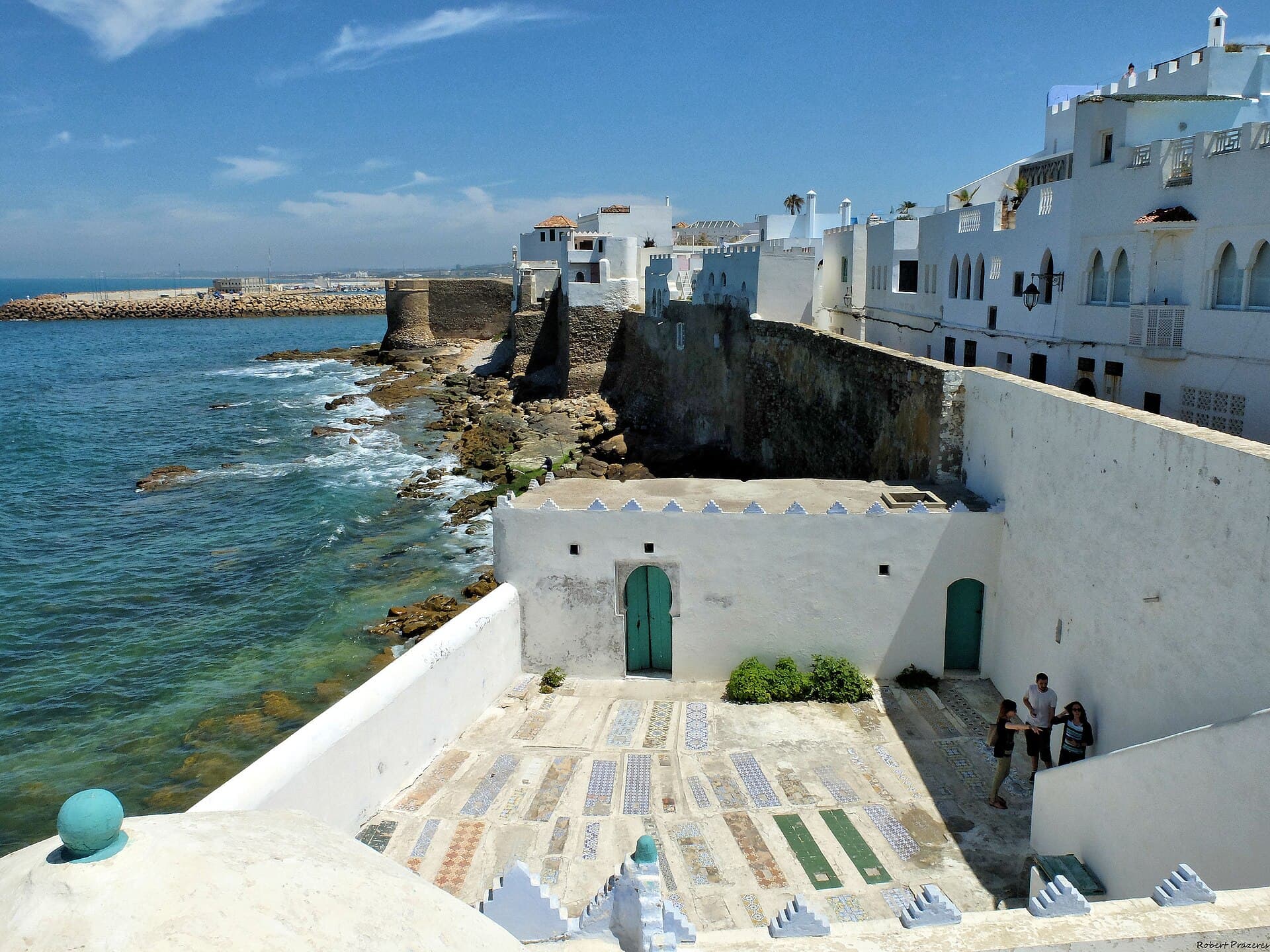 Robert Prazeres / CC BY-SA 4.0, via Wikimedia Commons
“Where ancient ramparts meet a living canvas by the Atlantic.”
Not the postcards. The stories even locals don't know — whispered in your ear, right where they happened.
Beyond its impressive stone archway, this gate holds a curious detail from a bygone era.
This grand mansion, once home to a notorious figure, is rumored to have a macabre architectural feature.
The pristine, whitewashed walls of Asilah's medina are not just for aesthetics; they serve a unique artistic purpose each year.
Discover every secret of Asilah
Every address, every reveal in full — in your ear, right where it happened.
You pick your stops. You walk. The voice reveals what the others miss.
No tours available yet. Check back soon — we're preparing them.
Asilah, a fortified town on Morocco's Atlantic coast, offers a serene escape from the country's more bustling cities. Located just 31 kilometers south of Tangier, this small town of around 36,000 residents maintains a pace closer to a Mediterranean fishing village. Its appeal lies in a distinctive blend of historical depth, a flourishing contemporary art scene, and uncrowded beaches.
The medina, with its whitewashed buildings and cobalt blue accents, feels like a living postcard. Unlike the intense energy of larger Moroccan medinas, Asilah's old town is notably calm, inviting visitors to wander its clean, compact streets without pressure. Here, the scent of fresh seafood mingles with the Atlantic breeze, and vivid murals adorn the walls, creating an open-air gallery that evolves with each passing year.
Asilah is a place where history is visibly etched into the Portuguese-built ramparts, and a modern artistic spirit breathes new life into ancient spaces. It is a destination that appeals to those seeking a relaxed coastal experience, genuine cultural encounters, and a chance to witness Morocco's artistic soul.
Asilah's origins stretch back to approximately 1500 BC, when Phoenician traders established a settlement known as Zilis, a key stop on their western Mediterranean trade network. The Carthaginians later incorporated the area into their commercial routes, followed by Roman control, though it never developed into a major urban center like Volubilis. The town itself was originally constructed by the Shia Idrisid dynasty, and later rebuilt by the Umayyad caliph Al-Hakam II in 966 AD.
The most visible chapter of Asilah's past began in 1471 when Portuguese forces captured the town and constructed the massive stone ramparts that still encircle the medina. These fortifications, along with the Bab Homar gate bearing the Portuguese coat of arms, remain largely intact. The Portuguese used Asilah as a strategic military outpost, and in 1578, King Sebastian launched his ill-fated crusade from here. Control shifted to Spain after this defeat, before the Saadian Sultan Ahmad al-Mansur reclaimed the town in 1589.
Spanish influence returned during the colonial period, with Asilah becoming part of the Spanish Protectorate in northern Morocco until independence in 1956. This era left an architectural footprint, including the Church of San Bartolomé, built by Spanish Franciscans in 1925, which still rings its bells for Sunday mass. In the 18th and 19th centuries, Asilah also served as a base for pirates, leading to a punitive bombardment by the Austrians in 1829.
A significant cultural renewal began in 1978 when local politician Mohamed Benaissa and artist Mohamed Melehi founded the International Cultural Moussem. This festival, which started as an initiative to invite artists to paint murals on the medina's walls, transformed Asilah into a recognized cultural event and an open-air gallery. The festival drew international attention, boosted tourism, and funded the restoration of Asilah's historic fortifications and buildings, solidifying its identity as Morocco's "art town."
Asilah's compact medina is best explored on foot, where whitewashed houses with blue or green accents create a calming atmosphere. The 15th-century Portuguese ramparts offer expansive views of the Atlantic, especially captivating at sunset from the Borj al-Kamra tower or the Krikia viewpoint.
Art is central to Asilah's identity, with lively murals adorning the medina walls, constantly refreshed by artists during the annual International Cultural Moussem. Small art galleries and artisan shops showcasing ceramics, lamps, and calligraphy prints can be found throughout the medina.
Beyond the medina, the town's main beach stretches below the ramparts, offering golden sands. For more secluded options, Paradise Beach (Kaf Lahmam or Las Cuevas), about 7 kilometers south, is a popular choice. The Thursday Souk, outside the medina walls, provides an authentic market experience for fresh produce, spices, and traditional goods.
Asilah enjoys mild temperatures year-round, with coastal breezes mitigating summer heat. The ideal times to visit depend on your preferences. For art enthusiasts, July and August are prime months, as the International Cultural Moussem fills the town with lively murals, music, and a festive atmosphere. However, this is also peak season, so expect more visitors.
For milder weather and fewer crowds, spring (April to June) and autumn (September to October) are excellent choices. During these periods, the weather is pleasant for exploring the medina and beaches, and the Atlantic light is ideal for photography. Winter (December to February) offers a quiet, peaceful experience, though it can be chilly with occasional rain.
Asilah is easily accessible, located about 31-45 kilometers south of Tangier. The most convenient way to arrive is by train from major Moroccan cities, with the journey from Tangier taking approximately 45 minutes. The train station is within walking distance of the medina. Alternatively, taxis and rental cars are viable options.
Within Asilah, the medina is pedestrian-only, and most attractions are within easy walking distance. Taxis are readily available for longer distances, such as to Paradise Beach. While Asilah is generally considered safe, particularly for solo female travelers due to its compact, close-knit community and low crime rate, it is always wise to exercise general travel caution. Modest dress is recommended out of cultural respect. Moroccan Dirham (MAD) is the local currency, and small banks are available for exchange.