Monte Verità
A serene incline above Ascona once fostered a radical experiment in communal living.
Full story unlocks in the tour
 Thomas Wenger / CC BY-SA 2.0, via Wikimedia Commons
“Where Swiss precision meets Mediterranean soul on Lake Maggiore.”
Not the postcards. The stories even locals don't know — whispered in your ear, right where they happened.
A serene incline above Ascona once fostered a radical experiment in communal living.
Ascona's animated lakeside promenade holds a surprising connection to a legendary American city.
One of Ascona's most elaborate buildings was constructed by a family whose influence extended far beyond the town's boundaries.
Discover every secret of Ascona
Every address, every reveal in full — in your ear, right where it happened.
You pick your stops. You walk. The voice reveals what the others miss.
No tours available yet. Check back soon — we're preparing them.
Ascona, a scenic town on the northern shore of Lake Maggiore in Switzerland's Italian-speaking Ticino canton, offers a captivating blend of Swiss order and Mediterranean allure. It holds the distinction of being the lowest-lying town in Switzerland, at 196 meters above sea level. Known for its exceptionally mild climate, Ascona is a haven of palm trees, pastel-colored buildings, and a relaxed, almost Italian, atmosphere.
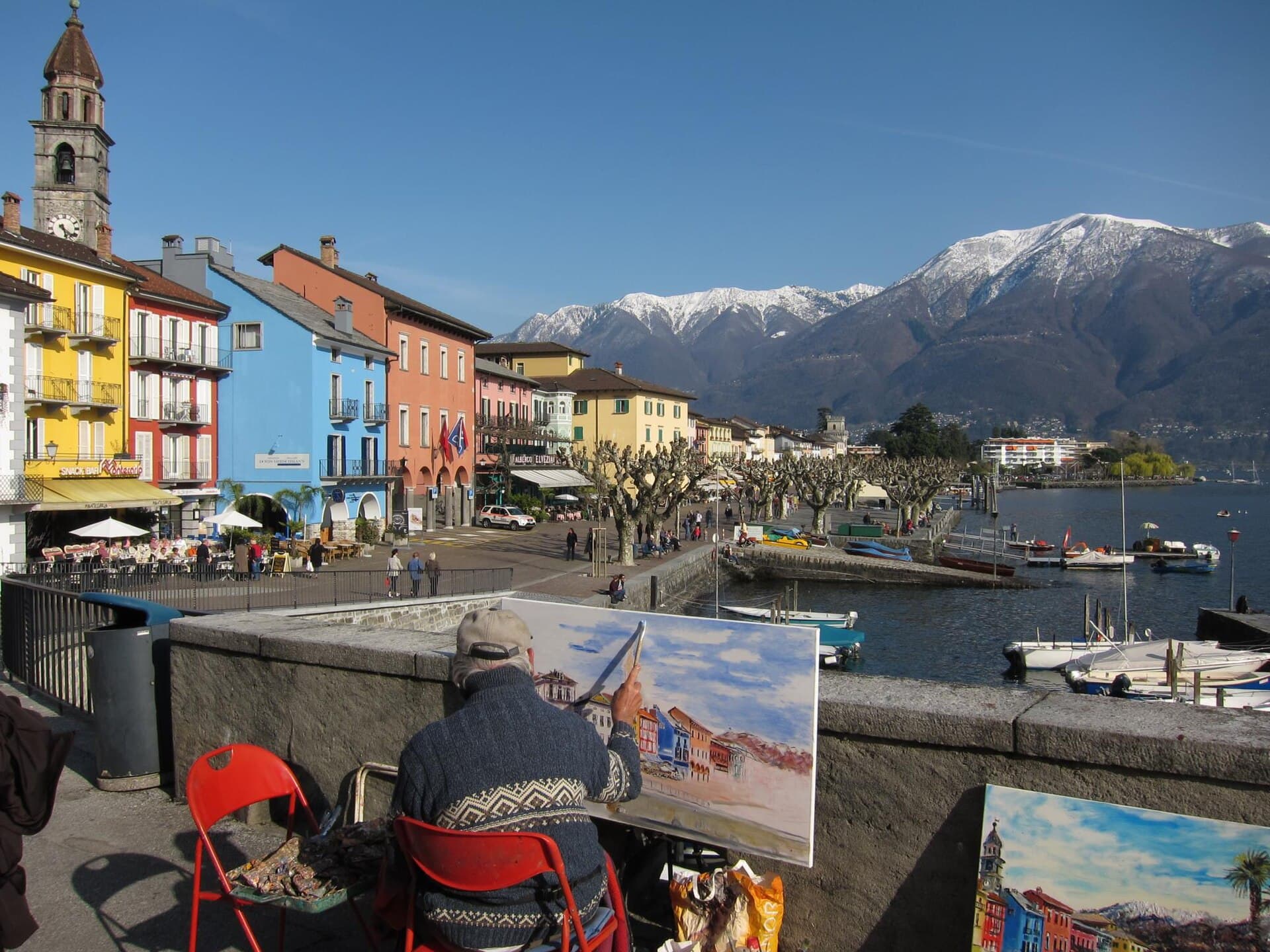
The town's core is its car-free lakeside promenade, the Lungolago, an animated stretch lined with cafés, boutiques, and restaurants offering views of Lake Maggiore and the surrounding mountains. Beyond the promenade, a labyrinth of narrow, winding streets forms the historic center, known as the Borgo, where small shops and art galleries invite exploration. Ascona's unique character has earned it accolades, including being named 'Swiss village of the year 2025'.
This lakeside destination draws those seeking both tranquility and cultural experiences, from water sports on Lake Maggiore to exploring nearby valleys and mountains. It seamlessly combines a laid-back atmosphere with a enduring artistic legacy, making it a distinctive stop for travelers in Southern Switzerland.
Ascona's history stretches back to at least the Late Bronze Age, with evidence of human settlement found in burial grounds containing urns and bronze artifacts. Its strategic location near the Maggia River delta meant it was traversed by ancient trade routes connecting the northern Alps and the Po Valley.
During the Middle Ages, Ascona developed into an important market town, fortified by local aristocratic families who built castles, some traces of which still exist. By 1369, Ascona had its own statutes and was closely linked with the nearby town of Locarno. The Church of SS Peter and Paul, first mentioned as a parish church in 1330, and the Church of S. Maria della Misericordia, built between 1399 and 1442, are notable medieval structures. The latter houses one of Switzerland's most extensive late Gothic fresco cycles.
In the 17th century, Ascona established itself as an independent town. The Collegio Papio, a seminary founded in 1580 by Bartolomeo Papio, and the 17th-century Church of Madonna della Fontana, a pilgrimage destination, further shaped the town's religious and educational landscape. The Casa Serodine, with its elaborately decorated facade, stands as a remarkable example of 17th-century profane architecture.
Until the early 20th century, Ascona's economy relied on agriculture, livestock, and fishing, alongside the emigration of skilled builders and artists to Italy. The late 19th century even saw a dynamite factory operate here, though it closed after explosions in 1874.
The early 20th century marked a significant shift with the establishment of a colony on Monte Verità, the 'Hill of Truth,' which attracted artists, writers, and free thinkers seeking a return to nature and alternative lifestyles. This cultural movement profoundly influenced Ascona's identity, fostering a legacy that continues to draw creative individuals. Tourism became a major economic driver in the 20th century, leading to substantial growth and the development of second homes. Notably, in March 1945, Ascona played a secret role in World War II, hosting negotiations between U.S. and Nazi German representatives regarding a German surrender in Italy.
Begin your exploration with a walk along the Lungolago, Ascona's palm-lined lakeside promenade. Here, colorful houses create a lively backdrop for cafés and boutiques, offering views across Lake Maggiore to the Brissago Islands. Wander through the narrow, winding lanes of the Borgo, the historic old town, where you'll discover artisan shops and art galleries. The 16th-century Church of San Pietro e Paolo, with its prominent bell tower, is a central landmark in the Borgo and features a baroque interior.
Ascend to Monte Verità, the 'Hill of Truth,' a short walk from Ascona. This historic site, once a vegetarian nudist colony and a gathering place for artists and intellectuals, now houses a museum, a Bauhaus-style hotel, and tranquil gardens with sweeping views. Take a boat trip to the Brissago Islands to explore the botanical gardens on San Pancrazio Island, home to over 1500 plant species. For art enthusiasts, the Museum of Modern Art in Ascona showcases works by artists connected to the region and European modernism. Do not miss the opportunity to experience the JazzAscona festival if visiting in late June or early July, or the classicAscona festival in autumn, both offering a comprehensive cultural program.
Ascona enjoys a mild, Mediterranean climate, making it an appealing destination for much of the year. The best time for warm-weather activities is from mid-June to mid-September, when average daily high temperatures are above 23°C (73°F), with July being the warmest month, averaging 27°C (80°F). This period is ideal for swimming and sailing on Lake Maggiore.
Late spring and early autumn (May, September, and October) also offer pleasant conditions with comfortable temperatures and magnificent views, though September can be moderately cool. Spring is characterized by mild temperatures, while autumn brings a favorable forecast for outdoor events. Even winter in Ascona is special, with a Mediterranean atmosphere, palm trees, and the possibility of snow-capped rooftops, making it suitable for relaxation, spas, and dining.
Ascona is located in the Ticino canton, the Italian-speaking region of Switzerland. While Italian is the official language, many in the tourism industry will speak German and English. The closest train station is in Locarno, just across the River Maggia, which is easily reachable from Ascona by car or public transportation. From Locarno, you can connect to various Swiss and international train routes.
For those staying one night or more in a hotel, campsite, or youth hostel, the Ticino Ticket offers free public transport across the region and discounts on various attractions. Ascona's town center and lakeside promenade are largely car-free, encouraging exploration on foot. While shops in Ascona can be high-priced, the town offers a selection of local boutiques and art galleries, particularly in the Old Town and along the promenade.