Piazza del Popolo
The gleaming travertine paving of Ascoli's main square holds a secret that reveals itself only when the skies open.
Full story unlocks in the tour
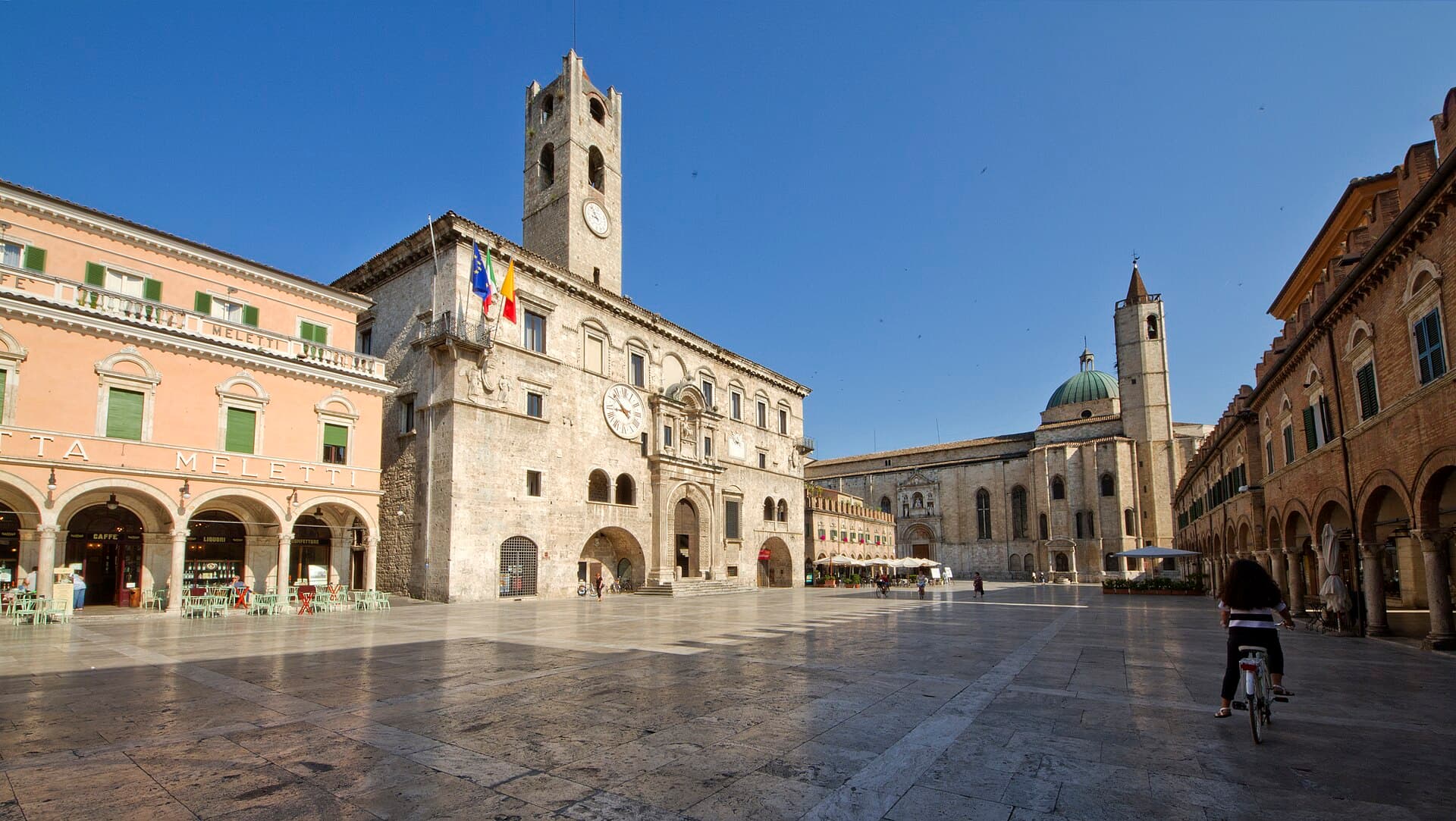 trolvag / CC BY-SA 3.0, via Wikimedia Commons
“Ascoli Piceno: Where ancient stone glows and history breathes through travertine arches.”
Not the postcards. The stories even locals don't know — whispered in your ear, right where they happened.
The gleaming travertine paving of Ascoli's main square holds a secret that reveals itself only when the skies open.
The grand facade of the Basilica di San Francesco conceals an unexpected musicality.
This ancient Roman bridge is veiled by a local story involving celestial knowledge and a dark pact.
Discover every secret of Ascoli Piceno
Every address, every reveal in full — in your ear, right where it happened.
You pick your stops. You walk. The voice reveals what the others miss.
No tours available yet. Check back soon — we're preparing them.
Ascoli Piceno, a city in Italy's Marche region, offers a journey through time, where every stone seems to narrate a tale. Known as the 'City of a Hundred Towers' and the 'Travertine City,' its historic core is almost entirely built from a pale, creamy travertine stone sourced nearby. This unique material lends Ascoli Piceno a luminous quality, particularly at sunset, contributing to its reputation as 'the Italian town that glows at night'. Positioned at the confluence of the Tronto and Castellano rivers and encircled by mountains, Ascoli Piceno provides a picturesque setting for exploring ancient Roman layouts, medieval pathways, and Renaissance architecture.
Frequently described as one of Italy's most beautiful and harmonious cities, Ascoli Piceno remains somewhat removed from the main tourist routes, offering an authentic Italian experience without large crowds. Its compact and easily traversed historic center invites unhurried exploration, where public spaces like the grand Piazza del Popolo act as the city's 'living room'—a place for residents and visitors to gather, stroll, and observe daily life. From its culinary delights, like the celebrated olive all'ascolana, to its profound cultural inheritance and lively festivals, Ascoli Piceno captivates with its blend of elegance, history, and genuine Italian character.
The history of Ascoli Piceno stretches back to ancient times, with findings indicating habitation in the Neolithic era. The city is even thought to have come into being several centuries before Rome. Its name is believed to derive from the Picene people, who, according to legend, were guided to the area by a woodpecker sent by the god Mars during a 'sacred spring season' procession. In the 3rd century BC, the Romans established Asculum as a key center, utilizing its strategic position on the Via Salaria. The Roman urban plan, with its distinct cardo and decumano street organization, is still discernible today. Roman remains can be explored in basements beneath the city, including the crypt of the cathedral in Piazza Arringo and below Palazzo dei Capitani in Piazza del Popolo.
Ascoli Piceno flourished in the Middle Ages, developing into a city with a skyline punctuated by towers, earning it the moniker 'City of a Hundred Towers'. At its peak, the city contained around 200 such structures, though many were later reduced or incorporated into other buildings by order of Frederick II, the Holy Roman Emperor. The city was governed by various seigniories, including the Malatesta and Sforza families, before coming under the control of the Papal State until the mid-19th century. This papal influence played a role in the consistent use of local travertine as the preferred building material, contributing to the city's architectural unity. Ascoli Piceno was also awarded the Gold Medal for Military Valour for its partisan activity during World War II.
Ascoli Piceno's historic center is a walkable composition of travertine, inviting exploration. The core of the city is Piazza del Popolo, a Renaissance-style square widely regarded as one of Italy's most beautiful. This pedestrianized space is framed by graceful arcades and significant buildings like the Palazzo dei Capitani del Popolo, a 13th-century palace that once housed the city's captains and now often hosts art exhibits. Adjacent to it is the historic Caffè Meletti, a Liberty-style institution ideal for an espresso or aperitivo.
Another important public space is Piazza Arringo, the city's oldest monumental square, which served as the Roman forum and remains a civic and religious center. Here you'll find the Ascoli Piceno Cathedral (Duomo di Sant'Emidio), which contains a polyptych by Carlo Crivelli and a crypt with mosaics. Other notable sights include the medieval Baptistery of San Giovanni, the Palazzo dell'Arengo (Town Hall), and the Civic Art Gallery. For a view into the city's ancient past, visit the Roman Theatre or the Fort Malatesta, a Renaissance-era fortress that once served as a prison and is now a museum. Take time to wander the winding streets, seeking out the remaining medieval towers that mark the skyline.
The best times to visit Ascoli Piceno are spring (mid-April to mid-June) and autumn (September to early October). During these periods, the weather is pleasant with mild temperatures, ideal for exploring the city on foot and enjoying outdoor activities. Summers (June to August) are warm and sunny, with average daily highs above 76°F (24°C), and can be a lively time to experience local festivals like the Quintana. Winters (December to February) are generally mild, offering a good opportunity to enjoy indoor attractions and local cuisine.
Ascoli Piceno is best explored on foot, as its historic center is compact and many streets are pedestrianized or too narrow for cars. To reach Ascoli Piceno, the most efficient way is often by car, with the city about a 2.5 to 3-hour drive from Rome. Alternatively, you can take a train to San Benedetto del Tronto on the Adriatic coast, then a connecting train to Ascoli Piceno (approximately 20-40 minutes). The closest major international airports are Rome Fiumicino (FCO), Ancona (AOI), and Pescara (PSR).
For accommodation, options range from hotels in the historic center to charming B&Bs. When it comes to dining, be sure to sample local specialties like olive all'ascolana (meat-stuffed fried olives), Vincisgrassi (a substantial lasagna-like dish), and local Pecorino cheese. The city is also known for its wines, such as Rosso Piceno and Passerina, and the anise-flavored liqueur, Anisetta Meletti.