Asahikawa Airport (AKJ)
This airport is a local legend for a surprising reason, especially given Hokkaido's famously heavy snowfall.
Full story unlocks in the tour
 水だらけのプール / CC BY-SA 4.0, via Wikimedia Commons
“Where Hokkaido's heart beats with a frosty charm and artisan spirit.”
Not the postcards. The stories even locals don't know — whispered in your ear, right where they happened.
This airport is a local legend for a surprising reason, especially given Hokkaido's famously heavy snowfall.
You might notice something unusual about the gas pumps in Asahikawa, a small detail that speaks volumes about daily life here.
One particular year, the festival's main snow sculpture achieved a monumental feat, earning it a place in the record books.
Discover every secret of Asahikawa
Every address, every reveal in full — in your ear, right where it happened.
You pick your stops. You walk. The voice reveals what the others miss.
No tours available yet. Check back soon — we're preparing them.
Asahikawa, the second-largest city in Hokkaido, Japan, offers a distinctive blend of urban amenities and natural splendor. Resting in the heart of the Kamikawa Basin, it serves as a central hub for northern Hokkaido, encircled by the towering peaks of the Daisetsuzan mountain range. The city is known for its inventive Asahiyama Zoo, its particular soy sauce-based ramen, and as a gateway to world-class ski resorts. With a population estimated at around 349,113 in 2026, Asahikawa provides a quieter, more local experience compared to its larger counterpart, Sapporo, making it an appealing destination for those seeking a laid-back exploration of northern Japan.
Asahikawa's character is shaped by its continental climate, which brings long, cold, and snowy winters, and comfortably warm, humid summers. The city is crisscrossed by approximately 130 rivers and streams, including the Ishikari River, and features over 740 bridges, with the iconic Asahibashi Bridge serving as a symbol since its completion in 1932. Recognized as a UNESCO Creative City of Design, Asahikawa cultivates a flourishing culture of arts and crafts, particularly in woodworking and furniture making, with a focus on designs that enhance everyday life.
## From Ainu Lands to Military Outpost Asahikawa's origins are deeply intertwined with the indigenous Ainu people, who inhabited these lands long before Japanese settlement. The city's name itself is a Japanese interpretation of an Ainu term, "Chiu-Pet," meaning "river with waves," which was mistakenly translated as "Chup-Pet" or "sun river," eventually leading to "Asahikawa," meaning "morning sun river."
In the late 19th century, during the Meiji period (1868-1912), the area saw the establishment of tondenhei, state-sponsored farmer-militia settlements. These military-agricultural settlers were instrumental in laying the foundation for the future city, developing a planned structure with a grid layout that still defines central Asahikawa today. The deployment of the Imperial Japanese Army's 7th Division further accelerated infrastructure development, transforming Asahikawa into a strategically important garrison city and stimulating its early growth.
## City Status and Industrial Growth Asahikawa was officially elevated to city status on August 1, 1922. It thrived as a military city leading up to World War II, during which it was bombed by American naval aircraft in July 1945. After the war, Asahikawa developed into a significant industrial center in Hokkaido, known for its lumber and brewing industries, as well as the production of furniture and paper pulp. The city's commitment to design was formally recognized on October 31, 2019, when it was designated a "Design City" by UNESCO's Creative Cities Network.
## Modern Milestones Over the decades, Asahikawa continued to grow and evolve. The Asahiyama Zoo, now world-renowned for its immersive enclosures, opened in July 1967. In 1972, Heiwa-dori Shopping Park, Japan's first permanent pedestrian mall, was established, becoming a lively center of shops and restaurants. The Asahikawa Winter Festival, a major annual event, has a history dating back to 1946, evolving from local efforts to clear snow into a celebrated display of massive snow and ice sculptures. Today, Asahikawa remains a vital transportation and distribution hub, playing a central role in northern Hokkaido's industry and commerce.
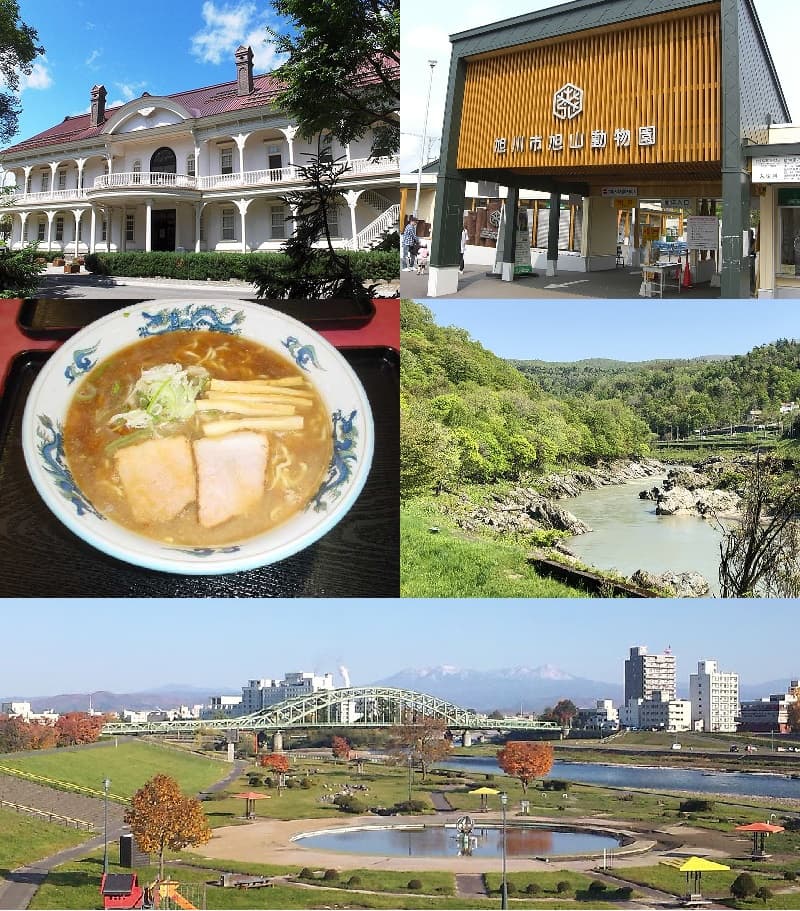
Asahikawa offers a variety of attractions that cater to different interests. The Asahiyama Zoo is a highlight, celebrated for its innovative enclosures that allow visitors to observe animals in environments mimicking their natural habitats, such as penguins swimming overhead in transparent tunnels. For culinary enthusiasts, Asahikawa Ramen Village is a destination, offering the city's signature soy sauce-based ramen with its savory pork broth and a distinctive layer of oil that keeps it warm.
Art and culture can be explored at the Asahikawa Museum of Art, which often features exhibits by local and international artists, with a particular focus on works made from wood. The Snow Crystal Museum provides a distinct experience, with displays of ice crystal images within a building designed to resemble a snowflake. For a taste of local craftsmanship, explore the shops around the city known for woodworking and furniture. The Otokoyama Sake Brewery and Museum offers insights into the sake-making process and includes opportunities for tasting. Those who appreciate nature can venture to Tokiwa Park, an urban green space with walking paths and seasonal flowers, or consider a day trip to Daisetsuzan National Park, accessible via the Asahidake Ropeway, for hiking and wildlife observation.
Asahikawa experiences distinct seasons, with activities varying significantly throughout the year. For warm-weather activities and comfortable temperatures (average highs around 26°C/79°F), the ideal time to visit is from early July to late August. This period is perfect for exploring parks, visiting the Asahiyama Zoo (which offers a special 'Night Zoo' in August), and taking day trips to nearby Biei and Furano for their celebrated flower fields.
Winter, from December to March, transforms Asahikawa into a snowy expanse, with average monthly temperatures below freezing and significant snowfall. This is the prime time for skiing and snowboarding at local resorts like Kamui Ski Links, Asahidake, and Furano. The Asahikawa Winter Festival, held for a week in early February, is a major draw, featuring colossal snow and ice sculptures, snow slides, and fireworks. Spring (April-May) and autumn (September-October) are transitional seasons, offering milder temperatures and opportunities to see cherry blossoms in May or brilliant autumn foliage.
Asahikawa Airport (AKJ) serves as the primary air gateway, offering flights to Tokyo (Haneda and Narita), Osaka (Kansai and Itami), and Nagoya. Buses connect the airport to central Asahikawa in approximately 35 minutes. For those traveling within Hokkaido, Asahikawa is well-connected to Sapporo by train, with the journey taking about 90 minutes on a limited express. The Japan Rail Pass covers JR train legs.
Within the city, Asahikawa's center is walkable, particularly around Asahikawa Station and the shopping streets. An extensive bus network serves as the main mode of public transportation, connecting the city center with attractions like Asahiyama Zoo. For greater flexibility, especially when exploring the more rural areas of Hokkaido like Biei or Furano, renting a car is suggested. Taxis are also readily available.