Arosa
The village of Arosa owes its transformation from a quiet alpine settlement to a renowned health resort to a chance discovery.
Full story unlocks in the tour
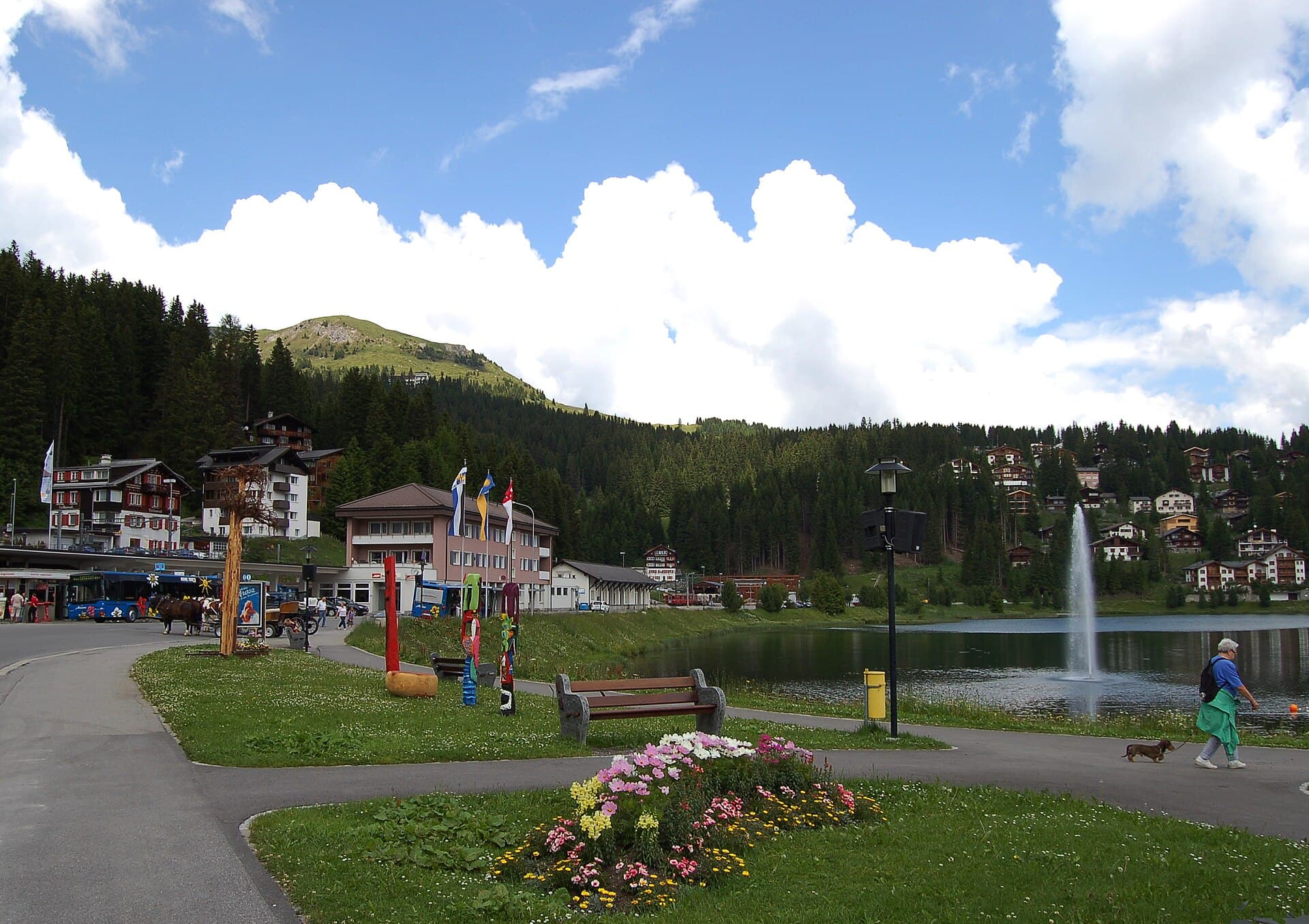 Ch-info.ch / CC BY 3.0, via Wikimedia Commons
“Where the road ends, a mountain fairytale begins.”
Not the postcards. The stories even locals don't know — whispered in your ear, right where they happened.
The village of Arosa owes its transformation from a quiet alpine settlement to a renowned health resort to a chance discovery.
The author of Sherlock Holmes played an unexpected role in popularizing skiing in Switzerland, with Arosa being a beneficiary of his adventurous spirit.
One of Arosa's modern hotels operates on a surprisingly innovative and eco-conscious system, beneath its stylish exterior.
Discover every secret of Arosa
Every address, every reveal in full — in your ear, right where it happened.
You pick your stops. You walk. The voice reveals what the others miss.
No tours available yet. Check back soon — we're preparing them.
Arosa, a captivating alpine resort village, rests at an elevation of 1,775 meters (5,823 feet) at the end of the Schanfigg Valley in Switzerland's eastern canton of Graubünden. This high-altitude location, encircled by forests, lakes, and towering peaks, offers a tranquil environment with no through traffic. Celebrated for its crisp alpine air and sunny climate, Arosa has evolved from a historical spa town into a year-round destination.
The village blends traditional alpine character with modern leisure, making it appealing for families, couples, and solo travelers seeking both relaxation and active pursuits. Arosa is part of the Arosa Lenzerheide ski region, one of Switzerland's largest, offering extensive outdoor activities across all seasons. Its dedication to environmental protection has earned it the 'Alpine Pearls' label, and the village is powered by renewable hydroelectric energy.
The history of human settlement in the Schanfigg valley, where Arosa is located, dates back to at least 765 AD, though Arosa itself was settled later. The inner part of the valley was inhabited during the 12th and 13th centuries by Walser people, who migrated from Davos across the Strela pass. Arosa is first mentioned around 1330 as 'Araus,' and by 1428, it appeared as 'Arosa.' For centuries, the village maintained a subsistence alpine pasture economy. Until 1851, Arosa was politically part of the Davos municipality, only accounting for 56 inhabitants in 1851.
The village's isolation began to change with improved transportation access. The road from Chur to Langwies opened in 1875, followed by the road from Langwies to Arosa in 1890. This accessibility led to Arosa's discovery as a tourist destination in the late 19th century. In 1877, the first guesthouse opened, and in 1888, Dr. Otto Herwig established the first sanatorium, marking Arosa's development as a health resort. Arosa's population grew significantly during this period, from 61 in 1870 to 1,071 by 1900.
Around 1900, Arosa's popularity surged as a summer retreat for those seeking cooler, peaceful locations. The early 20th century saw the gradual development of Arosa into a winter resort. A significant improvement in traffic access came with the construction of the Chur-Arosa railway line between 1912 and 1914, a daring engineering project at the time. The first ski lifts were installed in 1938, and in 1956, the impressive Arosa-Weisshorn resort lift opened, further solidifying its status as a winter sports hub. Health spas and sanatoriums were gradually converted into winter sports hotels.
In 2013, Arosa merged with several neighboring municipalities, forming the new municipality of Arosa. A major milestone for winter tourism occurred at the end of 2013 when the Arosa ski resort was linked with Lenzerheide by a cable car, creating the extensive Arosa Lenzerheide ski region, offering over 225 km of slopes. Today, Arosa maintains its character while offering a wide range of year-round activities, including the Arosa Bear Sanctuary, which opened in 2018.
Arosa offers a diverse array of attractions for all seasons. Take the Weisshorn cable car to 2,653 meters for expansive views of the Alps, the Schanfigg Valley, and even the Bernina Range on clear days. At the summit, you'll find a restaurant and viewing platform. For a unique animal encounter, visit the Arosa Bear Sanctuary, located at 2,000 meters near the Weisshorn cable car's middle station. This habitat provides a home for rescued bears, offering visitors observation platforms and educational exhibits.
Explore the Eichhörnliweg (Squirrel Trail), a family-friendly path where you can feed wild squirrels by hand. The village also features the picturesque Obersee lake, ideal for leisurely walks and boating, with a sandy beach area at Untersee for summer swimming. For a glimpse into the past, visit the Bergkirchli (Mountain Chapel), built around 1492, which is the oldest building in Arosa. The Eggahuus, Arosa's local history museum, provides an introduction to the village's past. In summer, the Arosa All-Inclusive Card, provided by hotels, grants free access to cable cars, local buses, pedal boats, the bear sanctuary, and discounts on other attractions.
Arosa is a year-round destination, with distinct appeals in both summer and winter. The summer season, from June to September, offers warm weather and clear trails, ideal for hiking, biking, and lakeside activities. Mid-summer generally provides drier, sunnier days. Winter, from late November to mid-April, transforms Arosa into a snow-covered landscape for skiing, snowboarding, and winter hiking. Late January to early March typically sees the most consistent snow. While February can be busy with European holidays, Arosa's high altitude ensures reliable snow cover into spring.
Arosa is accessible by both car and train. The scenic Arosa Line from Chur is a narrow-gauge railway that climbs over 1,000 meters in just over an hour, offering one of Switzerland's most beautiful train rides. If driving, be aware that the 30 km stretch from Chur is winding and steep, which can be challenging in poor winter conditions. The road terminates in Arosa, ensuring a peaceful, car-free village center. From Zurich Airport, the train journey to Arosa, with a change in Chur, takes approximately three hours.
Switzerland's currency, the Swiss franc, is used in Arosa. German is the main language, with a local dialect of Swiss German also spoken, though English is generally understood by locals. Many hotels offer the Arosa All-Inclusive Card during summer and autumn, providing free use of cable cars, local buses, and access to various attractions.