Armagh Robinson Library
Before digital downloads and e-readers, an 18th-century library in Armagh bore a poetic inscription above its entrance.
Full story unlocks in the tour
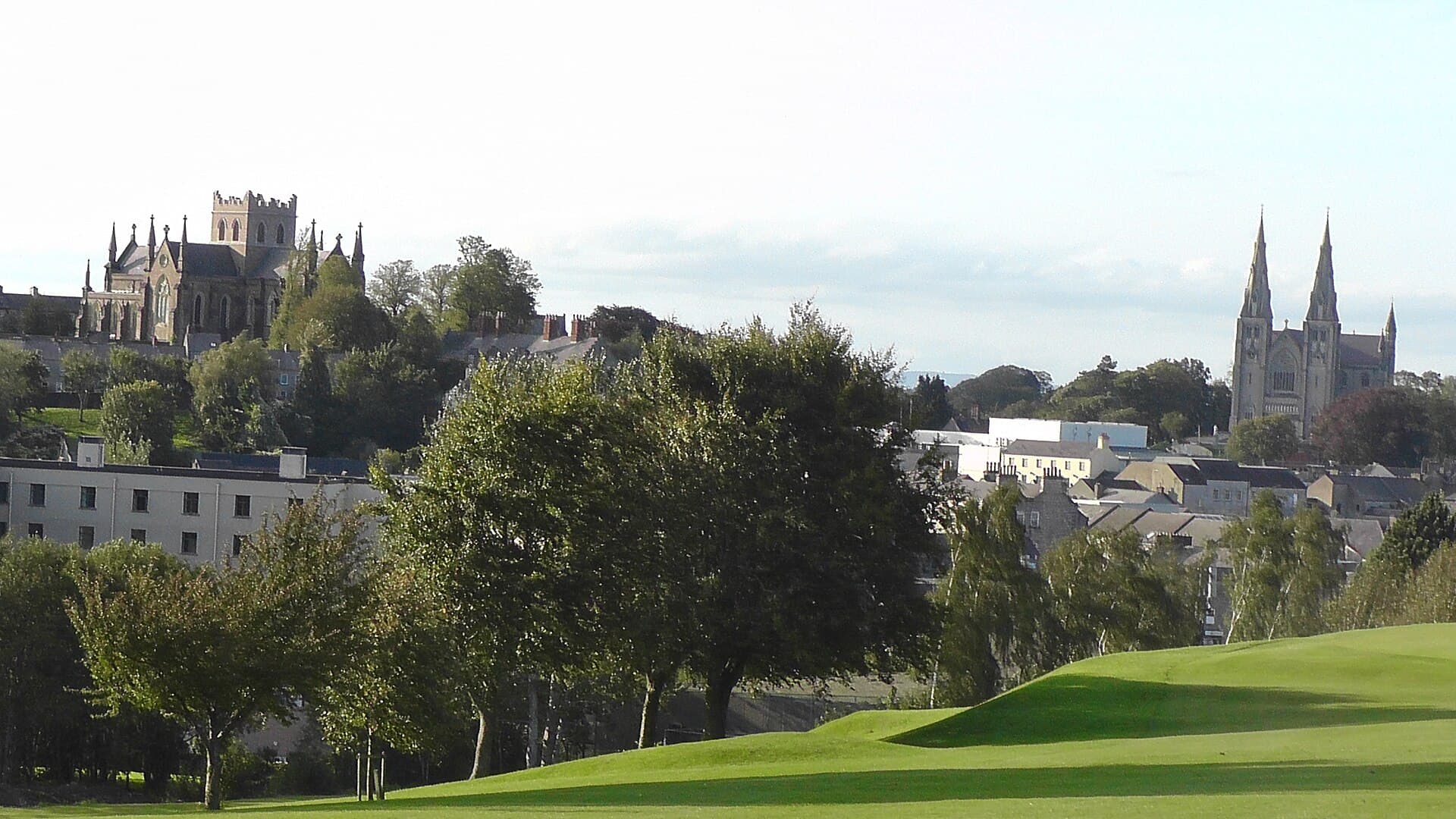 Sean Davis / CC BY-SA 2.0, via Wikimedia Commons
“Where ancient legends and celestial wonders converge.”
Not the postcards. The stories even locals don't know — whispered in your ear, right where they happened.
Before digital downloads and e-readers, an 18th-century library in Armagh bore a poetic inscription above its entrance.
Beneath the floor of Armagh's older cathedral lies a chamber that once safeguarded more than just religious artifacts.
Armagh hosts an astronomical institution that maintains a continuous record of something surprisingly earthly, stretching back over two centuries.
Discover every secret of Armagh
Every address, every reveal in full — in your ear, right where it happened.
You pick your stops. You walk. The voice reveals what the others miss.
No tours available yet. Check back soon — we're preparing them.
Armagh, frequently called the 'Ecclesiastical Capital of Ireland,' is a city where history is etched into every thoroughfare and rise of land. Its name, derived from the Irish 'Ard Mhacha' meaning 'Macha's height,' connects it to an ancient pagan goddess and a powerful royal domain. This compact city, though modest in scale, holds deep spiritual importance for both Roman Catholics and Protestants, serving as the seat of both Archbishops of Armagh.
Beyond its religious heritage, Armagh offers a journey through time, from prehistoric sites to elegant Georgian architecture. It is a place where old myths intertwine with scientific discovery, and where the 'Orchard County' moniker speaks to its fertile landscapes and celebrated Bramley apples. Armagh invites visitors to explore its distinctive blend of cultural depth, historical resonance, and natural beauty.
The area surrounding Armagh has been settled for approximately 6,500 years. In ancient times, the nearby Navan Fort (Eamhain Mhacha) was a significant pagan ceremonial site and one of the great royal capitals of Gaelic Ireland, serving as the center of the Ulaid kingdom. According to Irish mythology, it was named after the goddess Macha and was the legendary home of King Conor Mac Nessa and the Red Branch Knights. The site was largely abandoned after the 1st century.
Christianity arrived in the 5th century when Saint Patrick, according to tradition, established his principal church on the hill where the Church of Ireland Cathedral now stands in 445 AD. This act solidified Armagh's role as Ireland's ecclesiastical capital, a title it maintains to this day. By the 7th century, Armagh had grown into a vital center for churches, monasteries, and monastic schools in northern Ireland, producing important manuscripts like the Book of Armagh in the early 9th century.
The city faced numerous challenges throughout its existence, including frequent Viking raids between 831 and 1013. High King Brian Boru visited Armagh in 1004, acknowledging its status as the head church of Ireland and making a significant offering. He was later interred at the Church of Ireland Cathedral after his death in the Battle of Clontarf in 1014. Armagh's claim to primacy was formally recognized at the Synod of Ráth Breasail in 1111.
English influence became more prominent in the 17th century, leading to the Plantation of Ulster. The 18th century saw significant development under Archbishop Richard Robinson, who initiated numerous building projects, including the Armagh Public Library (1771) and the Armagh Observatory (1789). While Armagh lost its city status in 1840, it was ceremonially restored in 1994. The Roman Catholic St. Patrick's Cathedral, with its distinctive twin spires, was constructed in phases between 1840 and 1904, a testament to the enduring Catholic presence in the city.
Armagh offers a compelling blend of historical sites and cultural institutions. The city is famously home to two cathedrals, both dedicated to Saint Patrick and situated on opposing hills. St. Patrick's Church of Ireland Cathedral, constructed on the site of Saint Patrick's original 5th-century church, features a medieval crypt with ancient Celtic sculptures. Across the valley, St. Patrick's Roman Catholic Cathedral, with its striking twin spires, stands as a magnificent example of Neo-Gothic architecture.
Delve into the past at the Armagh Robinson Library, one of Ireland's oldest public libraries, established in 1771. It houses a rare collection of books, including a first edition of Gulliver's Travels with Jonathan Swift's handwritten notes, alongside ancient coins and prints. Adjacent to the Church of Ireland Cathedral, No. 5 Vicars' Hill, a restored 18th-century building, now serves as a museum displaying ancient coins, precious stones, and early Christian artifacts.
For a glimpse into ancient Irish history, the Navan Centre and Fort, just outside the city, interprets Eamhain Mhacha, an important pagan ceremonial site and former royal capital of Ulster. Look to the stars at the Armagh Observatory and Planetarium, Northern Ireland's oldest scientific institution, offering astronomical research and engaging exhibits, including Ireland's largest meteorite. Enjoy a stroll through the Palace Demesne, a 300-acre park that was once the residence of the Archbishops of the Church of Ireland, featuring formal gardens, meadows, and the remains of a 13th-century Franciscan Friary.
The ideal time to visit Armagh for outdoor activities extends from late June to late August, when the weather is mild with average daily temperatures ranging from 10–18°C (51–64°F). This period offers clearer skies and is perfect for exploring the city's attractions and surrounding landscapes. March is popular for the Home of St. Patrick Festival, a week-long celebration of Ireland's patron saint. September brings the Armagh Food and Cider Weekend, celebrating the region's renowned Bramley apples. For fewer crowds and potentially lower hotel prices, consider visiting during September to November, when autumn colors also appear.
Armagh is a walkable city, making it easy to explore its main attractions on foot. For those arriving by public transport, Armagh is accessible by bus from various locations, and the Enterprise train service connects Dublin and Belfast, with a stop at nearby Portadown, from which Armagh is a short bus ride away. If driving, follow the M1 west from Belfast to Craigavon, then the A3. From Dublin, take the M1/N1/A1 north to Newry, then the A28.
Accommodation options in Armagh City include hotels like the Armagh City Hotel, as well as comfortable B&Bs and self-catering cottages. Booking in advance is recommended, especially during festivals. While Armagh is generally safe, it's always wise to be aware of your surroundings. Visitor information and maps are available at the Armagh County Museum.