Santa Maria della Pieve
Examine the columns on the apse of the Santa Maria della Pieve church, especially the fifth from the left.
Full story unlocks in the tour
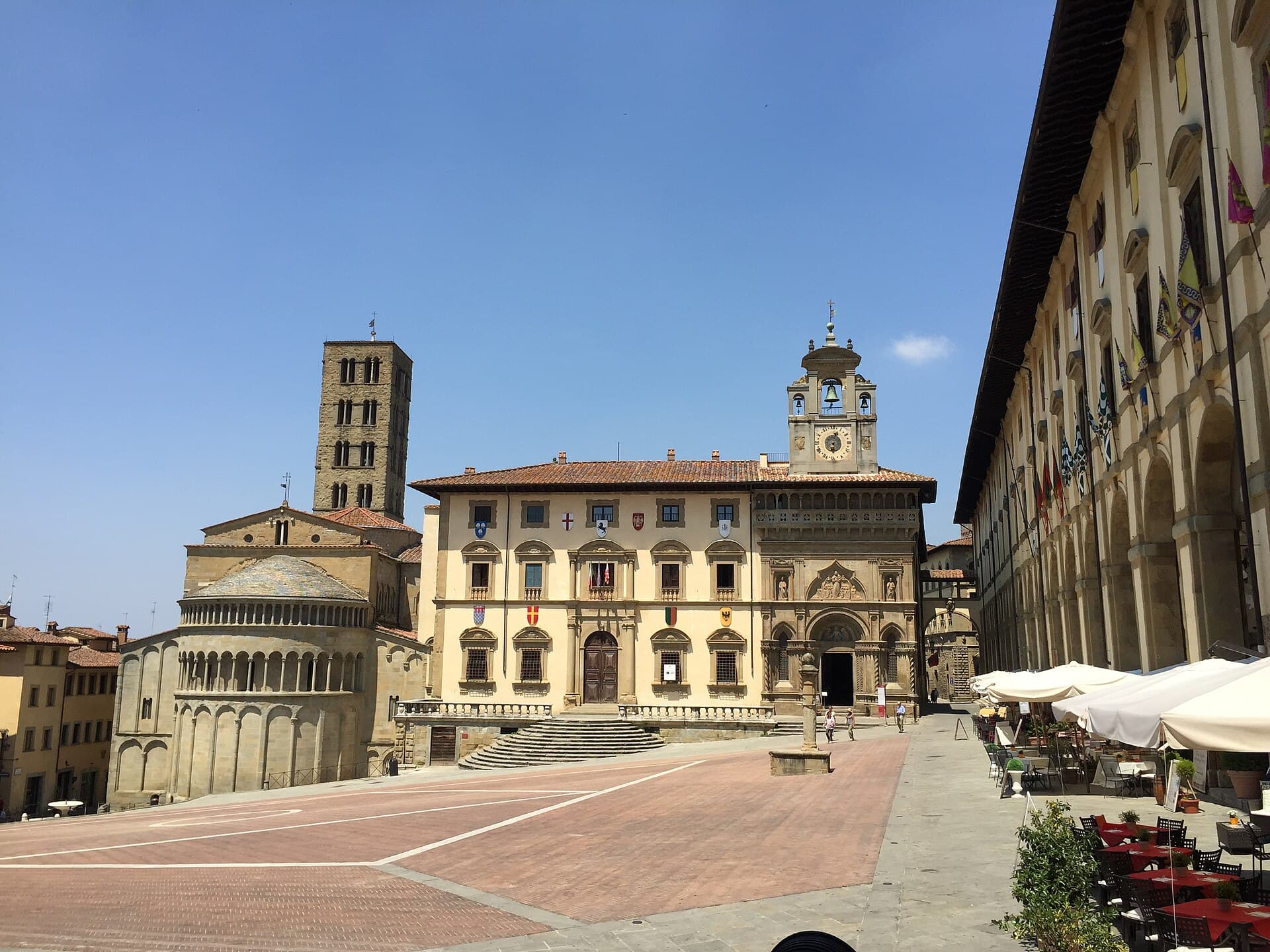 Andrewrabbott / CC BY-SA 4.0, via Wikimedia Commons
“Arezzo: Etruscan echoes mingle with Renaissance mastery and golden customs.”
Not the postcards. The stories even locals don't know — whispered in your ear, right where they happened.
Examine the columns on the apse of the Santa Maria della Pieve church, especially the fifth from the left.
The astronomical clock on the Palazzo della Fraternita dei Laici in Piazza Grande does more than simply mark the hours.
A celebrated fresco cycle inside the Basilica of San Francesco conceals a detail within its nighttime depiction.
Discover every secret of Arezzo
Every address, every reveal in full — in your ear, right where it happened.
You pick your stops. You walk. The voice reveals what the others miss.
No tours available yet. Check back soon — we're preparing them.
Arezzo, a city in eastern Tuscany, offers a compelling journey through time. Its foundations were laid by the Etruscans, and later, it flourished as a significant Roman center. Medieval walls still encircle parts of the old town, where the rhythm of daily life unfolds amidst ancient stones. The city's elevated position provides expansive views of the surrounding Chiana Valley, a landscape that has inspired artists and travelers for centuries.
The city's character is shaped by its artistic legacy, particularly the works of Piero della Francesca, whose frescoes draw admirers from across the globe. Beyond its artistic treasures, Arezzo maintains a deep connection to its artisan traditions, especially in goldsmithing. Workshops continue to craft intricate pieces, continuing a craft passed down through generations. This blend of profound artistic heritage, enduring craftsmanship, and a tangible sense of history defines Arezzo.
## Etruscan and Roman Origins Before the Romans established their dominance, Arezzo was one of the twelve principal cities of Etruria. Strategic for its position along the Via Cassia and its fertile lands, it became a significant Roman municipality, Arretium. Evidence of its Roman past can still be seen in the remains of an amphitheater, a testament to its former grandeur. The city was a crucial center for the production of 'Aretine ware,' a distinctive type of red-glazed pottery, widely exported throughout the Roman Empire. This early period established Arezzo's reputation as a place of skilled artisans and strategic importance.
## Medieval Flourishing During the Middle Ages, Arezzo emerged as an independent city-state, frequently clashing with neighboring Siena and Florence. Its medieval core, particularly around Piazza Grande, retains much of its original character. The city saw the construction of impressive churches and civic buildings, reflecting its growing wealth and influence. Figures like Guido of Arezzo, a Benedictine monk and music theorist, made profound contributions to musical notation, leaving a lasting impact on Western music. The city's medieval period was marked by both fierce independence and significant cultural development.
## Renaissance and Beyond The Renaissance brought a new era of artistic and intellectual activity to Arezzo. It became home to influential artists such as Piero della Francesca, whose frescoes in the Basilica of San Francesco are considered masterpieces of the early Renaissance. Giorgio Vasari, the celebrated painter, architect, and biographer of artists, was also born here, and his family home is now a museum. While it eventually fell under the dominion of Florence and the Medici family, Arezzo maintained its distinct identity and artistic traditions. The city's later history saw it adapt to changing political landscapes, yet it never lost its connection to its artistic and artisanal roots, particularly in the enduring craft of goldsmithing.
Piazza Grande, the city's main square, is an irregular, sloping space framed by medieval and Renaissance architecture. The square hosts the monthly Antiques Fair, a lively event drawing vendors and collectors. The Basilica of San Francesco houses Piero della Francesca's 'The Legend of the True Cross' fresco cycle, a pivotal work of the Renaissance. The Duomo di San Donato, Arezzo's cathedral, features stained-glass windows by Guillaume de Marcillat and a fresco by Piero della Francesca. The Museo di Casa Vasari, the former home of Giorgio Vasari, offers insight into the artist's life and work, filled with his own frescoes and art collection. For a quiet moment, the Passeggio del Prato, a public garden, offers views over the city and the surrounding valley.
Spring (April-May) and early autumn (September-October) offer pleasant weather, ideal for exploring the city on foot. The temperatures are mild, and the crowds are generally lighter than in the peak summer months. June brings the Giostra del Saracino, a traditional jousting festival, a spectacle of medieval pageantry.
Arezzo is well-connected by train, with direct services from Florence and Rome. The historic center is compact and best navigated on foot; comfortable shoes are advisable for the sloping streets. Parking is available outside the ZTL (Limited Traffic Zone) for those arriving by car. Many shops and restaurants observe a mid-day closure, typically between 1 PM and 4 PM, so plan your activities accordingly. English is spoken in tourist-oriented establishments, but learning a few basic Italian phrases will enhance your experience.