The Administrative Palace clock tower
The impressive clock tower of Arad's City Hall doesn't just tell time.
Full story unlocks in the tour
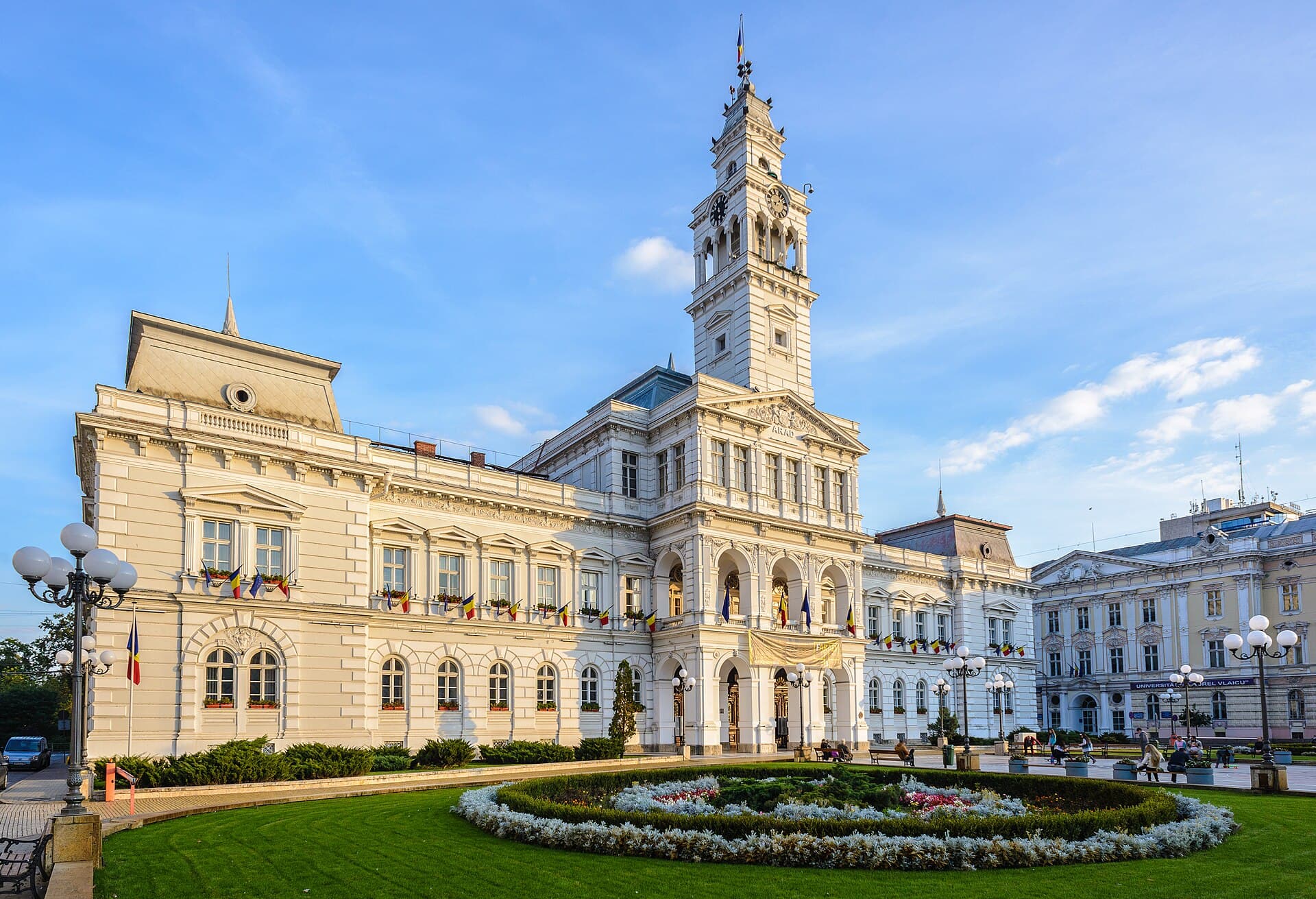 Nick Savchenko from Kiev, Ukraine / CC BY-SA 2.0, via Wikimedia Commons
“Arad: Where Central European grandeur meets Romanian spirit.”
Not the postcards. The stories even locals don't know — whispered in your ear, right where they happened.
The impressive clock tower of Arad's City Hall doesn't just tell time.
One of Arad's oldest secular buildings features a peculiar, brass-coated log embedded in its facade.
Arad has a long and innovative history with public transportation, including some surprising 'firsts' for the region.
Discover every secret of Arad
Every address, every reveal in full — in your ear, right where it happened.
You pick your stops. You walk. The voice reveals what the others miss.
No tours available yet. Check back soon — we're preparing them.
Arad, a city in western Romania, offers a compelling blend of enduring character, diverse architecture, and a relaxed atmosphere. Situated on the Mureș River, near the borders with Hungary and Serbia, Arad has been a crossroads of cultures for centuries. Often referred to as 'Little Vienna' due to its elegant Secessionist and Baroque buildings, the city invites exploration on foot, revealing grand palaces and charming squares. It's a place where Romanian, Hungarian, German, Serbian, and Jewish influences have shaped its identity, evident in its architecture and cultural institutions.
While not as widely known as some of Romania's more prominent destinations, Arad provides a genuine and unhurried experience. It's an important cultural and industrial center, with a past reaching back to the 5th century BC. The city's central area remains largely untouched by modern developments, preserving its historical character. Whether you're interested in architectural marvels, a stroll along the Mureș Promenade, or simply soaking in the local ambiance, Arad presents an engaging stop for travelers exploring this part of Europe.
The history of Arad stretches back to prehistoric times, with evidence of human settlements along the Mureș River as early as the Neolithic period. Dacian communities and later Roman influences marked its early development. The first documented mention of Arad dates from 1131. Over the centuries, Arad's strategic location meant it was frequently contested and ruled by various powers, including the Kingdom of Hungary, the Ottoman Empire, and the Austro-Hungarian Empire.
From approximately 1550 until 1700, Arad was largely under Turkish control, with brief interruptions. Following this, it came under the control of Austria and the Habsburg monarchy, a period that significantly influenced its architectural character. The Arad Fortress, a star-shaped Vauban-style fortification, was built between 1763 and 1783 under the orders of Habsburg empress Maria Theresa. This fortress played a crucial role in the 1848 Hungarian Revolution, enduring a nine-month siege. After the rebellion was suppressed, 13 Hungarian generals, known as the 'martyrs of Arad,' were executed here on October 6, 1849.
The late 19th and early 20th centuries saw rapid development in Arad, leading to many of the grand Art Nouveau and eclectic-style buildings that define its city center today. In 1834, Arad was granted the status of a 'Free Royal Town,' which further spurred its growth. Arad also holds significance in Romanian history; in 1918, it served as the headquarters for the National Romanian Central Council, which prepared the union of Transylvania with Romania. After World War I, under the Treaty of Trianon in 1920, Arad officially became part of Romania. In December 1989, Arad was the second city in Romania to join the revolutionary protests that ultimately led to the end of communism.
Most of Arad's important landmarks are concentrated in the city center, primarily along Bulevardul Revoluției, making it easily walkable. Begin at the Administrative Palace, a Renaissance Revival masterpiece from 1876 that houses the City Hall. Its 54-meter tower features stained-glass windows depicting the seasons. A short walk away is the Cultural Palace, an architectural blend of neoclassical, Gothic, and Renaissance styles, which is home to the local museum and the State Philharmonic.
Continue to Avram Iancu Square, a pleasant space surrounded by Art Nouveau and neoclassical buildings, including the Ioan Slavici Classical Theatre, built in 1874. The grand St. Anthony of Padova Church, a neo-Renaissance cathedral, stands out along the boulevard. Do not overlook the Red Church, a Gothic Revival structure known for its striking red brick exterior. While the Arad Fortress, a star-shaped Vauban fortification, is visually impressive, it is currently under military jurisdiction and generally only open for special events. For a different perspective, stroll along the Mureș Promenade, offering green spaces and views of the river.
The best time to visit Arad for warm-weather activities is from late May to mid-September. During these months, temperatures are mild to warm, with July and August seeing average highs around 29°C. Spring (May to June) and early autumn (September to October) offer pleasant weather and fewer tourists, making them ideal for sightseeing. While summers are generally sunny, thunderstorms can occur. Winters are cold, with January being the coldest month, but severe frosts are infrequent.
Arad International Airport (ARW) is located 4 km west of the city center and has a cargo terminal. For more extensive passenger connections, Timișoara Traian Vuia International Airport (TSR) is about 60 km south. Arad is well-connected by train, with direct routes to major Romanian cities like Timișoara, Oradea, and Bucharest, as well as international connections to Budapest. The Arad Central Railway Station is about 2 km north of the city center.
Within the city, public transport primarily relies on trams and buses, with a single-journey ticket costing 4 lei (as of May 2026, the municipality plans to cut the daily fee to RON 1). Taxis and car rentals are also available. The local currency is the Romanian Leu (RON). Many establishments in the city center accept card payments, but it's always useful to carry some cash. Romania is in the Eastern European Time (EET) zone (UTC+2), with daylight saving time (EEST, UTC+3) observed in summer.