The Arch of Trajan
This grand Roman arch, a landmark for sailors across centuries, once held a gleaming secret upon its marble frame.
Full story unlocks in the tour
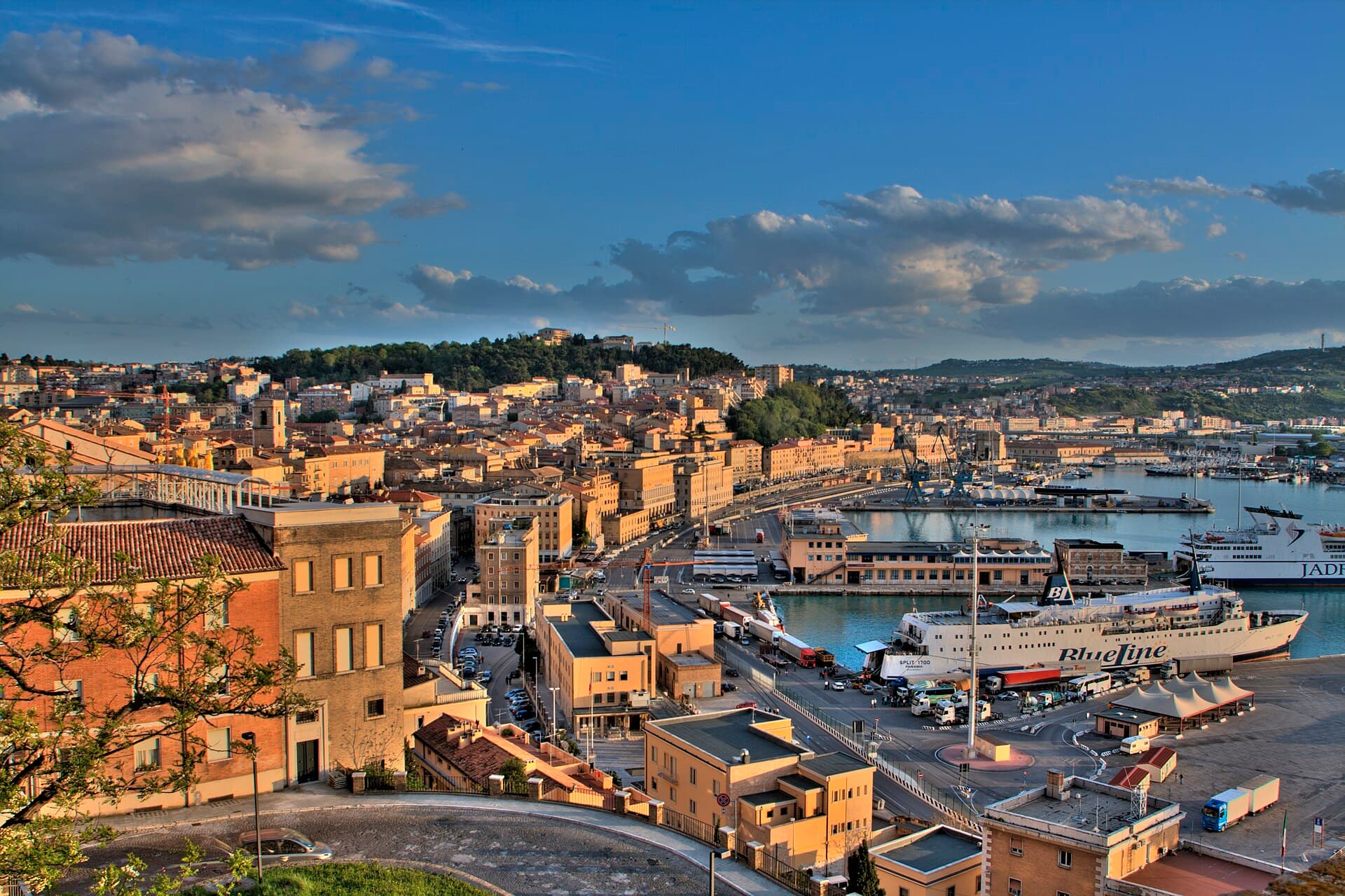 Enrico Matteucci from Camerano, Ancona / CC BY 2.0, via Wikimedia Commons
“Where ancient stones meet the Adriatic breeze.”
Not the postcards. The stories even locals don't know — whispered in your ear, right where they happened.
This grand Roman arch, a landmark for sailors across centuries, once held a gleaming secret upon its marble frame.
Beneath the elegant promenade of Passetto, a network of over 500 hand-dug 'caves' reveals a surprising story of local ingenuity.
Beyond the grand Roman and Clementine arches, the ancient port preserves a medieval structure that miraculously endured devastating wartime bombings.
Discover every secret of Ancona
Every address, every reveal in full — in your ear, right where it happened.
You pick your stops. You walk. The voice reveals what the others miss.
No tours available yet. Check back soon — we're preparing them.
Ancona, the capital of Italy's Marche region, is a city where millennia of human endeavor are etched into a dramatic coastal landscape. Its name, derived from the Greek word "Ankṓn" meaning "elbow," perfectly describes its unique promontory, which cradles one of the finest natural harbors on the Adriatic. This strategic location has shaped Ancona's destiny, transforming it from a Greek colony founded around 387 BC by Syracusan settlers into a vital Roman port and, later, a powerful maritime republic.
Today, Ancona remains a bustling port city, serving as a significant gateway for passenger traffic across the Adriatic. Its urban fabric is a compelling blend of ancient Roman architecture, medieval austerity, and elegant 18th-century design, all stitched together with modern developments that emerged after the extensive damage of World War II. As you explore, you'll find a city that offers a genuine Italian experience, less frequented by mass tourism than some of its more famous counterparts, yet profound in cultural depth and scenic beauty.
One of Ancona's most captivating features is its ability to offer both sunrise and sunset views over the sea from the same geographical point—a rare phenomenon in Italy and indeed, the world. This unique perspective, combined with its historical layers and a lively local atmosphere, makes Ancona a destination that rewards curious travelers seeking an authentic encounter with Italy's Adriatic soul.
## From Greek Colony to Roman Gateway Ancona's story begins around 387 BC, when Greek colonists from Syracuse established a settlement, drawn by the natural, elbow-shaped harbor that offered excellent protection. They named it "Ankṓn," meaning "elbow," a name that endures to this day. The early city retained a distinct Greek character, even minting its own coins and maintaining Greek cultural traditions.
By the 2nd century BC, Ancona came under Roman influence, quickly becoming a crucial naval base and a key "gateway to the East." Emperor Trajan, recognizing its strategic importance, personally financed a significant expansion of the port around 115 AD. This modernization included the construction of new moles and fortifications, solidifying Ancona's role as a vital logistical hub for the Roman Empire. The iconic Arch of Trajan, designed by Apollodorus of Damascus and erected in 115 AD, stands as a testament to this period of imperial investment and Ancona's prominence.
## A Maritime Republic and Papal Rule Following the fall of the Western Roman Empire, Ancona became one of the cities of the Pentapolis of the Exarchate of Ravenna, a lordship of the Byzantine Empire, in the 7th and 8th centuries. After Charlemagne's conquest of northern Italy, it became the capital of the Marca di Ancona, from which the modern region takes its name. From the 11th century onwards, Ancona asserted its independence, evolving into a powerful oligarchic maritime republic. It rivaled Venice for dominance in the Adriatic, even minting its own currency, the silver agontano, and later, the gold agnoto or Ancona Ducat. The city was strong enough to repel forces from the Holy Roman Empire on multiple occasions and its ships participated in the Crusades. In 1532, Ancona definitively lost its freedom and became part of the Papal States under Pope Clement VII.
## Modern Challenges and Resilience The 16th century saw Ancona become an important destination for merchants from the Ottoman Empire, with a significant Greek community establishing itself in the city. During the Risorgimento, Ancona actively participated in the struggles for Italian unification. The city's strategic port made it a target during both World Wars. In World War I, the Austro-Hungarian Navy heavily bombed Ancona in 1915. During World War II, Allied bombings destroyed approximately 70% to 75% of the historic center. The city was eventually taken by the Polish 2nd Corps in July 1944, a crucial step in shortening Allied supply lines for the advance into northern Italy. Despite these devastations, Ancona has rebuilt and retained its unique character, blending its ancient past with a resilient modern identity.
Ancona offers a compelling blend of historical sites and sweeping coastal views. Begin your exploration at the Ancona Cathedral (Cattedrale di San Ciriaco), a Roman-Gothic basilica set atop Guasco Hill. Built on the remains of a temple dedicated to Venus and an early Christian basilica, it offers wide vistas of the city and port.
Descend towards the old harbor to discover the Arch of Trajan, an elegant Roman triumphal arch from 115 AD, constructed from Turkish marble. Nearby, you'll find the 18th-century Clementine Arch, another gateway to the city designed by Luigi Vanvitelli. The Mole Vanvitelliana, a striking pentagonal building also by Vanvitelli, originally served as a lazaretto for quarantine and now hosts cultural events.
Stroll through Piazza del Plebiscito, known locally as "Piazza del Papa" (Pope's Square), a long, sloping square that serves as a central gathering place, especially lively in the late afternoon. For art enthusiasts, the Francesco Podesti Civic Art Gallery in Palazzo Bosdari houses a significant collection, including works by Titian, Carlo Crivelli, and Lorenzo Lotto. The National Archaeological Museum of the Marche, located in the 16th-century Palazzo Ferretti, showcases artifacts from the Palaeolithic to the Classical period, offering insights into the region's ancient history.
For a refreshing break, head to Cardeto Park, a green area on Cardeto Hill. It features the old lighthouse, a monumental Jewish cemetery (one of Europe's largest), and offers expansive sea views. And don't miss Passetto Beach, a popular spot with distinctive "caves" carved into the rock by locals for boat storage, and the impressive War Memorial (Monumento dei Caduti).
The best times to visit Ancona are spring (mid-April to mid-June) and autumn (September to October). During these periods, the weather is mild, and the city experiences fewer crowds, making it ideal for exploring historical sites and the Conero Park. While some rainy days are possible, the light is clear and temperatures are comfortable for walking the city's hilly streets. For beach activities, July and August offer warm, sunny weather, though these are also the peak tourist months with higher prices.
Ancona is generally a secure city, but it's always wise to take standard precautions against pickpocketing in busy areas like the port and train station. The local currency is the Euro (€). While credit cards are widely accepted, carrying cash for smaller purchases like coffee or bus tickets is recommended. ATMs are readily available.
Italian is the main language. English is often spoken in hotels and larger tourist-oriented restaurants, but less so in smaller, family-run establishments. Comfortable walking shoes are essential, as Ancona is built on hills with steep streets and stairs, particularly when visiting the Cathedral of San Ciriaco. The city center is best explored on foot, though public transport options are available. Ancona Centrale is the main railway station, located at Piazza Rosselli, offering connections to major Italian cities. For emergencies, dial 112.
Compared to major Italian art cities like Rome or Florence, Ancona is generally more affordable. Hotel prices rise during the peak summer months of July and August, so booking in advance is advisable if traveling during this period.