Amiens Cathedral
This monumental Gothic cathedral holds a relic that pilgrims flocked to see, yet its authenticity is widely debated.
Full story unlocks in the tour
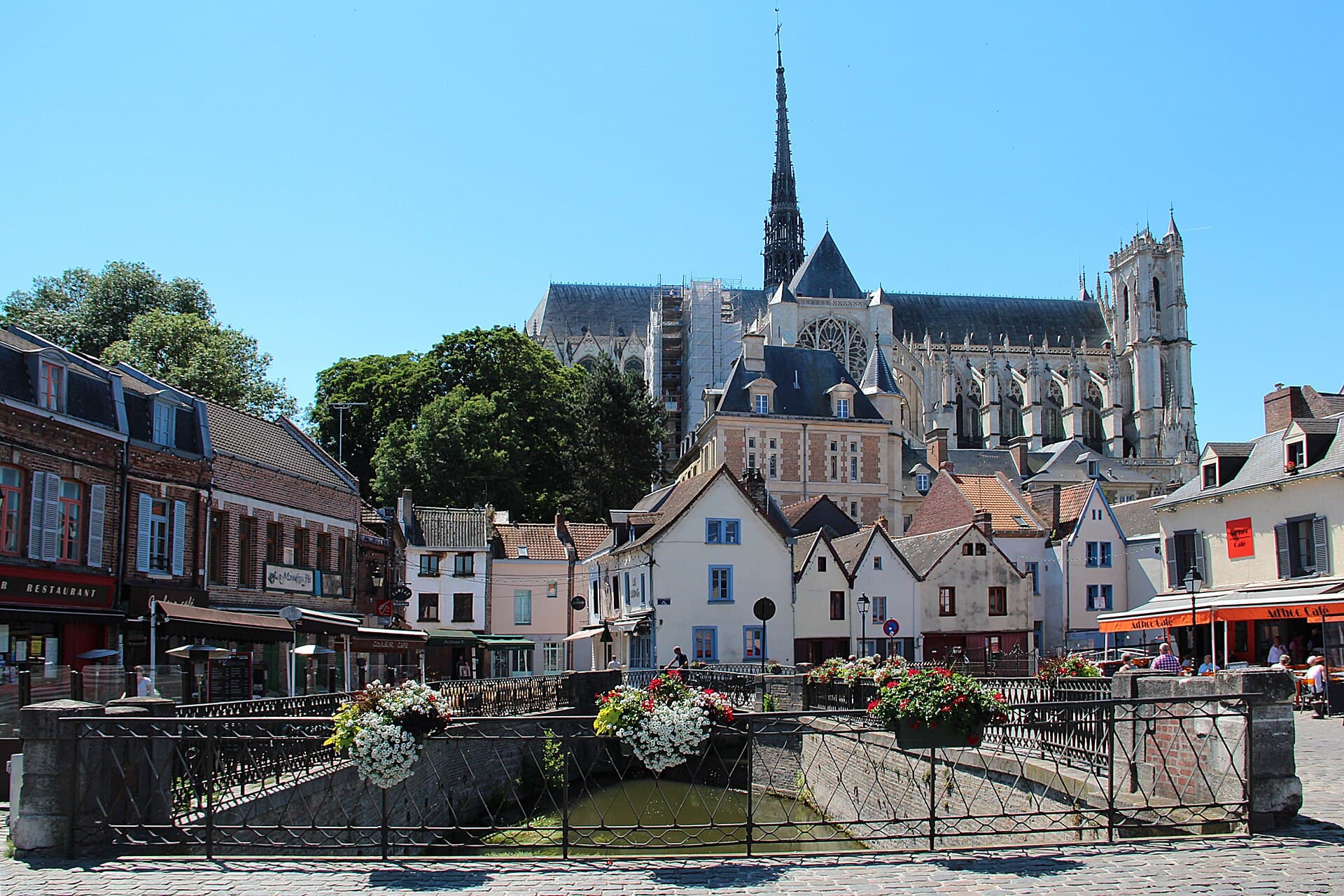 Jean-Pol GRANDMONT / CC BY-SA 3.0, via Wikimedia Commons
“Where Gothic grandeur meets floating gardens and literary dreams.”
Not the postcards. The stories even locals don't know — whispered in your ear, right where they happened.
This monumental Gothic cathedral holds a relic that pilgrims flocked to see, yet its authenticity is widely debated.
These serene floating gardens, cultivated for centuries, were almost lost to a modern development project.
The famous author, who penned over 30 novels here, had a very particular way of conducting his extensive research without leaving Amiens.
Discover every secret of Amiens
Every address, every reveal in full — in your ear, right where it happened.
You pick your stops. You walk. The voice reveals what the others miss.
No tours available yet. Check back soon — we're preparing them.
Amiens, the capital of the Somme department in the Hauts-de-France region, is a city where history, literature, and nature intertwine. Often called the "Little Venice of the North" due to its intricate network of canals and floating gardens, the hortillonnages, Amiens offers a unique blend of urban charm and natural tranquility. Just 120 kilometers north of Paris, it's a destination that invites exploration, from its awe-inspiring Gothic cathedral to the former home of one of the world's most imaginative writers, Jules Verne.
The city's character is defined by the Somme River, which meanders through its heart, creating picturesque districts like Saint-Leu with its colorful houses and waterside ambiance. Amiens is a city that has gracefully rebuilt itself after significant damage during both World Wars, particularly after the 1918 Battle of Amiens, a pivotal moment in World War I. Today, it stands as a testament to resilience, offering visitors a peaceful yet engaging experience full of culture and natural beauty.
Amiens' origins trace back to Roman times, when it was known as Samarobriva, meaning "Somme bridge" in Gaulish, serving as a central settlement for the Ambiani tribe. It was a significant hub on the Roman road connecting Lyon to Boulogne, fostering early development. Christianization arrived early, with Saint Fermin becoming the first bishop in 287 AD, later martyred in 303 AD. A notable event in the city's early history is when a Roman soldier, Martinus, later known as Saint Martin of Tours, shared his coat with a poor man in Amiens during the winter of 338-339.
The city faced challenges from Viking raids in 859 and 882, which led to the destruction of its first cathedral. Amiens gained its first charter of municipal rights in 1113, asserting independence against local lords, and by 1185, it became part of the Royal domain of France.
The 13th century marked a period of immense architectural ambition with the rapid construction of the Amiens Cathedral, largely completed between 1220 and 1270. This masterpiece of Gothic architecture was commissioned after a fire destroyed the previous Romanesque cathedral in 1218, and its construction was partly fueled by the city's acquisition of the reputed skull of John the Baptist in 1206, which drew numerous pilgrims. The city's strategic importance led to it being ceded to the Duke of Burgundy in 1435 by the Treaty of Arras, only to be reacquired by King Louis XI in 1477. In 1597, the Spanish captured Amiens using a Trojan horse tactic, prompting a six-month siege by King Henry IV to reclaim the city.
The 18th and 19th centuries saw Amiens flourish as a center for the textile industry, particularly renowned for its velvet production. The Treaty of Amiens, a peace agreement between France and Britain, was signed here by Napoleon Bonaparte in 1802. The Industrial Revolution brought changes, including the dismantling of city walls to make way for wider streets and the arrival of the first railway in 1848, connecting Amiens to Boulogne-sur-Mer.
Amiens endured significant damage and occupation during both World Wars. The 1918 Battle of Amiens was a crucial turning point, marking the beginning of the Hundred Days Offensive that ultimately led to the end of World War I. The city was heavily bombed again by German forces in 1940 during World War II. Post-war, Amiens was rebuilt with wider streets and new buildings often constructed from brick, concrete, and white stone. The Tour Perret, one of Europe's first skyscrapers, was built between 1948 and 1954, dominating the skyline alongside the cathedral.
Begin your exploration at the Amiens Cathedral, a UNESCO World Heritage site and the largest Gothic cathedral in France by volume. Its intricate facade, adorned with hundreds of statues, and its soaring nave, reaching 42 meters in height, are truly remarkable. During summer and the festive season, the cathedral's facade comes alive with the "Chroma" sound and light show, recreating its original painted appearance.
Just a short walk from the city center, discover Les Hortillonnages, a unique network of floating gardens crisscrossed by 60 kilometers of narrow canals, or "rieux." These former marshlands, cultivated for over 800 years by market gardeners known as "hortillons," can be explored on guided electric boat tours or by renting a traditional barque à cornet. From May to October, the Festival Art, Villes & Paysage transforms the gardens with contemporary art installations.
Delve into the world of Jules Verne at the Maison de Jules Verne, where the renowned author lived from 1882 to 1900. This house-museum offers a glimpse into his life and inspirations, featuring his study, library, and personal artifacts across four richly restored floors. Don't miss the octagonal Municipal Circus, inaugurated by Jules Verne himself in 1889, as he was an elected town councilor.
Stroll through the picturesque Quartier Saint-Leu, known as the "Little Venice of the North," with its canals, colorful houses, and lively atmosphere. The Musée de Picardie, inaugurated in 1867 with Jules Verne present, houses an extensive collection spanning from the Palaeolithic era to the 21st century.
For a different perspective, observe the Tour Perret, a 29-story residential tower built between 1948 and 1954, which was once one of Europe's tallest buildings.
Amiens is a destination that can be enjoyed year-round, but the sweet spot for warm-weather activities and outdoor exploration is from late spring to early autumn (May to September). During these months, the weather is pleasant, ideal for boat trips in the hortillonnages and dining al fresco. July and August offer the warmest temperatures, with average highs around 72°F (22°C). December is particularly magical, as the city hosts one of northern France's largest Christmas markets, transforming the city center with festive decorations. If you prefer fewer crowds and potentially lower prices, consider visiting during the shoulder season, such as March, when accommodation costs are typically lower to mid-range.
Amiens is well-connected by train, with regular Intercités and TER services from Paris (1 to 2 hours) and other major French cities arriving at the Gare d'Amiens, conveniently located in the city center. For high-speed TGV trains, a shuttle bus connects to Gare TGV Haute-Picardie, about 50 km east of Amiens. The local public transport network, Ametis, operates numerous bus lines and electric bus lines, providing good coverage throughout the city and its surrounding areas. While Amiens does not have a tramway, the bus system is efficient. Cycling and walking are also encouraged, with bike rental stations available.
The city center is largely pedestrianized, so if driving, consider parking in one of the underground parking lots. Amiens is generally considered a safe city for tourists. For comprehensive assistance, the Amiens Métropole Tourist Office is located on the cathedral square and offers information, maps, and leaflets. Consider purchasing the Amiens Cœur de Somme City Pass, available for 24, 48, or 72 hours, which offers free or discounted access to many attractions, including the Cathedral, Jules Verne House, and Musée de Picardie.