The Koppelpoort
This enduring medieval gate was more than a barrier; its operation demanded considerable human effort.
Full story unlocks in the tour
 Torsade de Pointes / CC0, via Wikimedia Commons
“Where ancient gateways usher in contemporary rhythms.”
Not the postcards. The stories even locals don't know — whispered in your ear, right where they happened.
This enduring medieval gate was more than a barrier; its operation demanded considerable human effort.
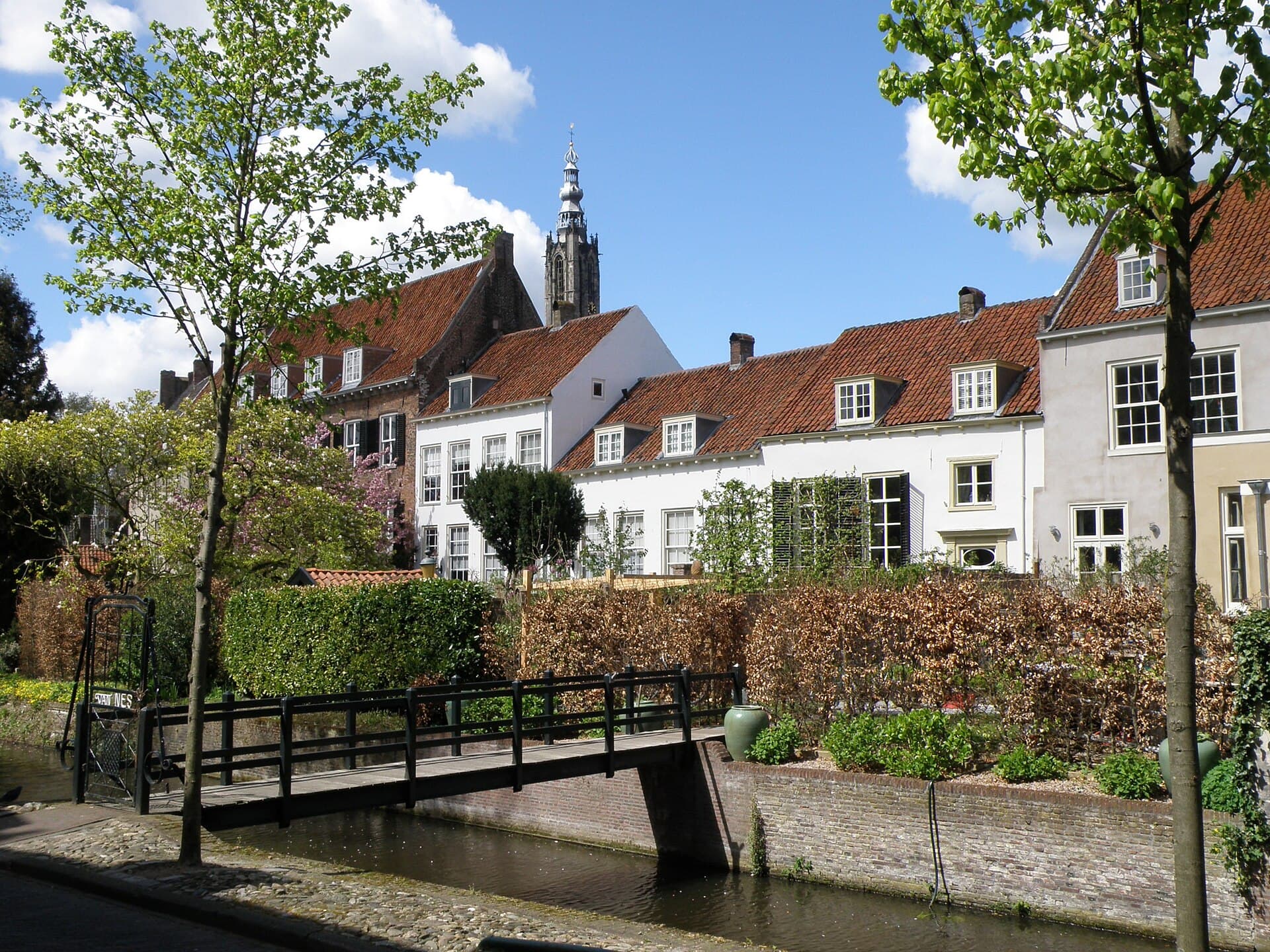
These gracefully curved homes recount a story of urban growth and clever repurposing.
This soaring landmark stands solitary for a poignant reason, offering more than just a grand panorama.
Discover every secret of Amersfoort
Every address, every reveal in full — in your ear, right where it happened.
You pick your stops. You walk. The voice reveals what the others miss.
No tours available yet. Check back soon — we're preparing them.
Amersfoort, a city in the Dutch province of Utrecht, presents an engaging fusion of medieval character and modern vibrancy. Its name, signifying 'ford on the Amer River' (now the Eem), alludes to its origins as a pivotal crossing point. The city's immaculately preserved medieval core, with its time-worn thoroughfares and historic structures, beckons exploration. Amersfoort was even honored as European City of the Year in 2024, recognized for its architecture and the quality of life enjoyed by its inhabitants.
Beyond its scenic canals and ancient city gates, Amersfoort is a place that has gracefully embraced both its heritage and its future. From the distinctive 'Wall Houses' built upon medieval foundations to its lively cultural landscape, Amersfoort offers an authentic Dutch encounter away from the more crowded tourist paths. It is a city where history is not merely kept intact; it is intricately woven into the fabric of everyday existence, providing a refreshing perspective on the Netherlands.
The narrative of Amersfoort commences with a simple settlement around a ford in the Amer River, now known as the Eem, with evidence of habitation reaching back to 1000 BC. The city's designation, 'Amersfoort,' itself mirrors this early geographical significance. By the 11th century, the Bishops of Utrecht established a court here to oversee the Gelderse Vallei area, laying the groundwork for its subsequent evolution.
Amersfoort received city rights in 1259 from Bishop Henry I van Vianden, a crucial moment that stimulated its urbanization and the construction of its initial defensive wall around 1300. As the city thrived and expanded, a second, larger wall began construction in 1380 and was completed around 1450, effectively doubling the city's area. This second wall incorporated the impressive Koppelpoort, a distinctive combined land and water gate that stands to this day.
During the Middle Ages, Amersfoort prospered as a significant hub for the textile industry and brewing, owing to its access to clean water from the Eem River. The city also became an important pilgrimage destination after the discovery of a miraculous statue of the Virgin Mary in 1444, which led to the construction of the Onze-Lieve-Vrouwetoren. This era of prosperity, however, was not without its trials, including the expulsion of Jewish residents from the province in 1546, though they began to return in 1655.
Amersfoort earned its characteristic nickname, 'Keistad' (boulder-city), from an unusual event in 1661. Four hundred residents, motivated by a wager between two landowners, pulled a 9-tonne boulder from the Soest moors into the city. The reward for their efforts? Beer and pretzels. This boulder, initially a source of embarrassment, was rediscovered in 1903 and now stands as a monument near the city center.
The 18th century witnessed a surge in tobacco cultivation, further contributing to the city's affluence. However, a decline followed around 1800. The 19th century brought new life with the arrival of the railway in 1863, transforming Amersfoort into a major railway junction and a garrison town. Today, Amersfoort continues its evolution, balancing its medieval heritage with modern urban development, as evidenced by its contemporary cultural centers like the Eemhuis.
Commence your exploration at the Koppelpoort, a remarkable medieval gate that uniquely combines land and water access, dating back to approximately 1425. Observe it from the exterior or join a guided tour to witness its original treadwheel mechanism. Nearby, the Muurhuizen (Wall Houses) offer an engaging stroll along a curved street where homes were constructed using the bricks of the first city wall.
Dominating the skyline is the Onze-Lieve-Vrouwetoren (Our Lady's Tower), a 98-meter Gothic tower, the third tallest church tower in the Netherlands. Ascend its 346 steps for expansive city views. The tower also holds the distinction of being the reference point for the Dutch national grid. Do not overlook the Hofje De Armen de Poth, a historic almshouse complex with medieval origins, providing a serene escape. For art enthusiasts, the Mondriaanhuis is the birthplace of Piet Mondrian, displaying his early works and artistic evolution.
Immerse yourself in local history at Museum Flehite, housed within three medieval buildings that were once part of the city wall. Discover the city's waterways with a canal tour on the Eem River, offering a different perspective on Amersfoort's historic architecture.
The ideal time to experience Amersfoort's allure for warm-weather pursuits is from late June to early September. During these summer months, average daytime temperatures range from 18-23°C, perfect for walking through the city and enjoying outdoor activities. Spring (March-May) and autumn (September-November) offer milder temperatures, ranging from 7-15°C, with blossoming flowers in spring and colorful leaves in autumn. While winter (December-February) is cooler, with average temperatures around 2-6°C, it presents a quieter period for museum visits and indoor explorations.
Amersfoort is readily accessible, with direct train services from major Dutch cities such as Amsterdam (approximately 50 minutes) and Utrecht (around 20 minutes). Amersfoort Centraal serves as a significant railway junction. If arriving by air, Amsterdam Schiphol Airport (AMS) is the most convenient, offering direct train connections. The city center is compact and best explored on foot, with most primary attractions within walking distance of each other. Public transport within Amersfoort is efficient, and buses can transport you from the train station to the old town in about 5 minutes. Consider parking outside the city center if arriving by car, then walking or taking a bus. Canal tours operate from May to September, providing a relaxing way to view the historic waterways. The local currency is the Euro (€).