Ilha do Amor
This iconic 'island' isn't always an island.
Full story unlocks in the tour
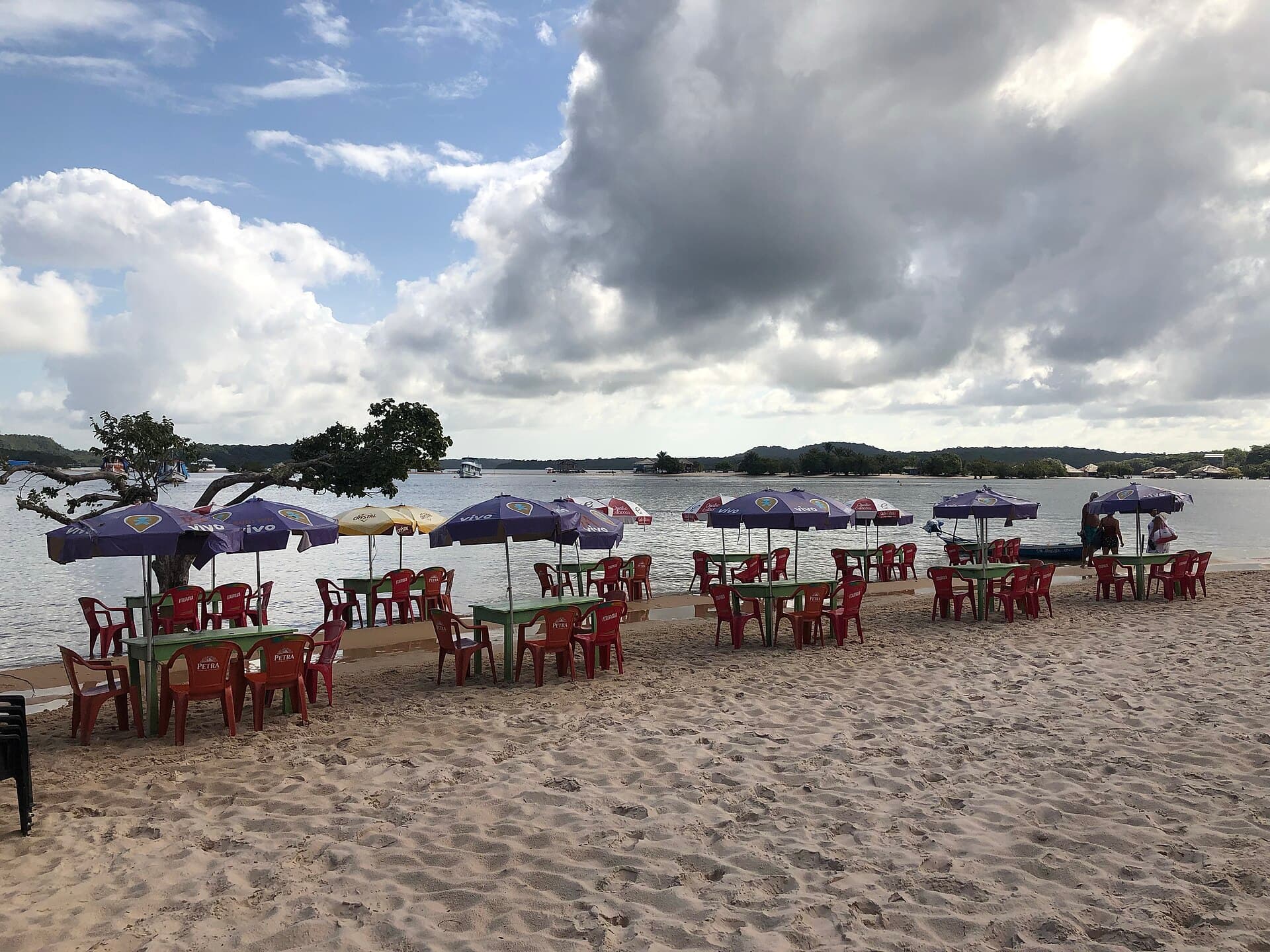 Richard N Horne / CC BY-SA 4.0, via Wikimedia Commons
“Where the Amazon meets the Caribbean: white sands and emerald waters in the heart of the rainforest.”
Not the postcards. The stories even locals don't know — whispered in your ear, right where they happened.
This iconic 'island' isn't always an island.
The Tapajós River has a secret that defies Amazonian expectations.
Some of the most captivating boat tours here don't happen on the river, but *through* the forest.
Discover every secret of Alter do Chão
Every address, every reveal in full — in your ear, right where it happened.
You pick your stops. You walk. The voice reveals what the others miss.
No tours available yet. Check back soon — we're preparing them.
Alter do Chão, a village in the Brazilian state of Pará, presents a singular fusion of Amazonian wildness and immaculate freshwater beaches. Frequently called the 'Caribbean of the Amazon,' it is where the clear, blue-green waters of the Tapajós River converge with expansive white-sand river beaches. This tranquil location, a district of Santarém, offers an escape into nature with a relaxed, bohemian atmosphere.
Beyond its renowned river beaches, Alter do Chão serves as a gateway to the profound biodiversity and cultural ancestry of the Amazon. Travelers can explore national forests, encounter local communities, and immerse themselves in the rhythms of river life. The village itself, with a population of approximately 7,000, maintains a charming simplicity, inviting all to experience its singular natural splendor and lively local customs.
Alter do Chão's story is a narrative woven from indigenous inheritance, Portuguese colonization, and economic shifts. The village was established on March 6, 1626, by Portuguese explorer Pedro Teixeira. In the 17th and 18th centuries, Jesuit missionaries founded religious missions in the area, introducing the reverence of Our Lady of Remedies, who became the patron saint of the place.
Until the 18th century, the Borari indigenous communities were the primary inhabitants, leaving behind archaeological evidence such as pottery shards and polished stone axes. The village's designation itself honors the Portuguese town of Alter do Chão.
The early 20th century brought a brief interval of economic growth as Alter do Chão became an important transportation route for latex extracted from rubber trees in nearby Belterra and Fordlandia. Henry Ford even attempted to establish rubber plantations in the Amazon, including the adjacent Fordlandia, although these ventures ultimately faced difficulties and were sold to the Brazilian government. However, with the decline of Amazonian rubber extraction in the 1950s, the village experienced an economic downturn.
Since the 1990s, Alter do Chão has successfully reoriented its economy towards tourism, drawing visitors with its natural splendor and singular cultural offerings. Today, it is recognized internationally, having been named the most beautiful freshwater beach in Brazil by The Guardian in 2009. The annual Sairé Festival in September, a tradition extending back at least 300 years, displays the region's indigenous and religious cultural origins, attracting thousands of visitors.
The most celebrated attraction is Ilha do Amor (Love Island), a sandy peninsula that forms directly across from the town center during the dry season, providing a picturesque setting for swimming and relaxation. You can reach it by a brief boat ride or, when water levels are low, by wading across.
Explore Lago Verde, a local favorite for escaping crowds, accessible by boat. During high water, the surrounding forest becomes submerged, creating an 'enchanted forest' where you can glide through treetops. For expansive views of Alter do Chão, Lago Verde, and the Tapajós River, ascend to the summit of Morro da Piroca (Piroca Hill), the highest elevation in the area.
A visit to the Tapajós National Forest (FLONA) offers immersive jungle experiences, including guided walks to ancient Samaúma trees, learning about medicinal plants, and swimming in clear igarapés (shallow rivers). Boat tours to Canal do Jari provide opportunities to observe wildlife like caimans, river dolphins, and sloths, and visit a giant water lily garden. Do not miss observing the sunset at Ponta do Cururu, a favored location where boat tours often conclude their day.
The optimal time to journey to Alter do Chão is during the dry season, known as the Amazonian summer, which typically spans from August to December. In these months, river levels recede, revealing the famous white-sand beaches, including Ilha do Amor. The weather is generally sunny and warm. The rainy season, from January to July, brings higher river levels, submerging many beaches but presenting distinct opportunities for canoe tours through flooded forests.
To arrive in Alter do Chão, first fly to Santarém (STM), which offers direct flights from major Brazilian cities such as Brasília, Belém, and Manaus. From Santarém, Alter do Chão is approximately a 35-40 km drive. Taxis and transfers are available, costing around R$130-R$150, or a more economical public bus option runs frequently. An adventurous alternative is a multi-day ferry journey along the Amazon River from Manaus or Belém to Santarém.
English is not widely spoken, so acquiring some fundamental Portuguese phrases will be advantageous. The local cuisine, often termed 'Tapajônica,' is a blend of Amazonian and Paraense flavors, featuring fresh fish, açaí, and manioc flour. While generally considered secure for travelers, customary travel precautions are advised.