Corral de Comedias
This 17th-century theater holds a secret within its walls, a small discovery that speaks to the everyday lives of its earliest audiences.
Full story unlocks in the tour
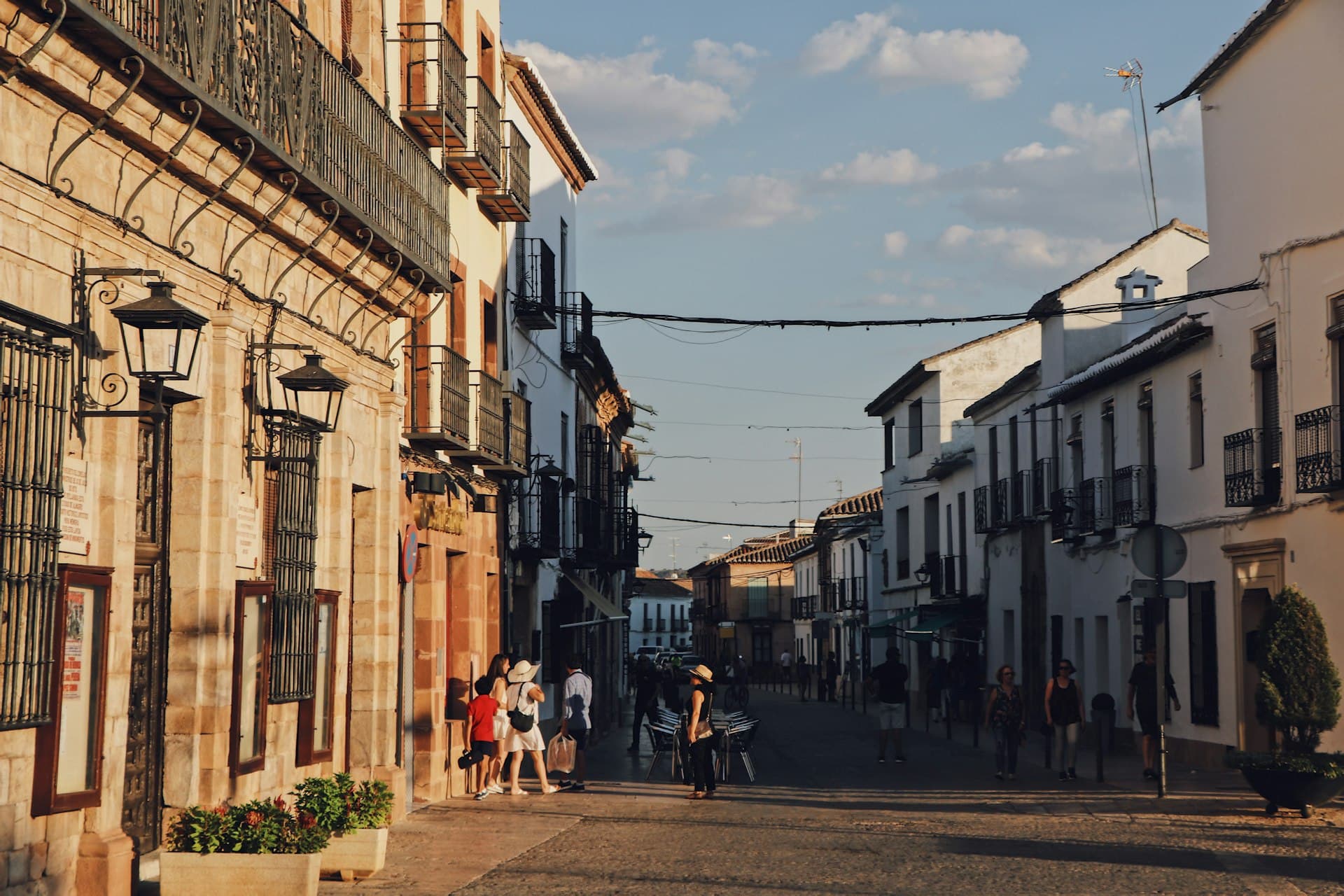 Photo: Wei Huang / Unsplash
“Where Golden Age drama echoes in sun-drenched courtyards.”
Not the postcards. The stories even locals don't know — whispered in your ear, right where they happened.
This 17th-century theater holds a secret within its walls, a small discovery that speaks to the everyday lives of its earliest audiences.
The distinctive green-tinted glass galleries of Almagro's Plaza Mayor aren't merely decorative; they conceal a practical, and rather shrewd, origin.
Almagro is renowned for its delicate bobbin lace, but the origins of this intricate craft in the town might surprise you, with a connection stretching far beyond Spain's borders.
Discover every secret of Almagro
Every address, every reveal in full — in your ear, right where it happened.
You pick your stops. You walk. The voice reveals what the others miss.
No tours available yet. Check back soon — we're preparing them.
Almagro, a town in the heart of Spain's Castile-La Mancha region, is a designated Historical-Artistic Site, celebrated for its remarkably preserved medieval architecture and cultural heritage. Its stone-paved streets invite exploration, leading to a central Plaza Mayor that is one of Spain's most distinctive squares.
The town's identity is deeply intertwined with the history of theater, most notably through its 17th-century Corral de Comedias, a singular open-air theater that continues to host performances. Beyond its theatrical fame, Almagro offers a glimpse into a past shaped by military orders, influential bankers, and a tradition of delicate lacemaking.
Almagro's history truly begins in the 13th century, when it became the administrative capital of the powerful Military Order of Calatrava. This religious order held significant political sway during the Late Middle Ages, and Almagro flourished as its center of governance. A local tradition credits Don Gonzalo Yánez, a Master of the Order, with granting the town its charter in 1213, a decree later confirmed by King Ferdinand III of Castile in 1222.
The town experienced its zenith in the 16th and 17th centuries, a period often referred to as Spain's Golden Age. This prosperity was partly fueled by the arrival of influential European families, such as the German Fugger bankers, who settled in Almagro. The Fuggers acquired considerable possessions in Spain under Emperor Charles V, including concessions on the important mercury mines of Almadén, in exchange for loans to the Spanish government. Their influence is evident in the architecture of the Plaza Mayor, which took on its present form with distinctive galleries during this era.
The 17th century also saw the construction of the Corral de Comedias in 1628 by Leonardo de Oviedo, a cleric. This open-air theater, built within the courtyard of an old inn, is considered the only intact example of a Golden Age theater in the world. While the office of Master of the Order was incorporated into the Crown of Castile in 1487, marking a decline for the Calatravan knights, Almagro continued to thrive. The 18th century brought further development, with the town briefly serving as the provincial capital of La Mancha from 1750 to 1761, thanks to the patronage of Philip V and the Conde de Valdeparaíso. Efforts were also made to promote commerce, particularly in textiles and lacemaking, during this time. In the 20th century, the rediscovery and restoration of the Corral de Comedias in the 1950s, followed by the declaration of Almagro as a Historical-Artistic Zone in 1972, cemented its place as a significant cultural and historical destination.
The Plaza Mayor is the heart of Almagro, a rectangular square framed by stone arcades and unique two-story wooden balconies with green-tinted glass. This architectural style is rare in Central Europe and Spain. From here, step into the Corral de Comedias, the only 17th-century open-air theater preserved in its original form and still in use. A guided tour offers insight into its history and the performances of Spain's Golden Age.
Adjacent to the Plaza Mayor is the National Theatre Museum, which houses extensive collections on the history of Spanish performing arts, including stage designs, costumes, and model theaters. Explore the Palacio de los Fúcares, a 16th-century Renaissance building that once served as a warehouse for mercury from the Almadén mines and grain. Wander through the Barrio Noble to see emblazoned houses like the Casa del Mayorazgo de los Molina and the Casa de los Rosales, as well as palaces such as the Palacio del Maestral and the Palacio de los Condes de Valparaíso. Do not miss the Convent of the Assumption of Calatrava, a 16th-century convent with a striking cloister featuring Ionic and Tuscan columns.
The best times to visit Almagro are from late spring to early autumn, specifically May, June, and September, when temperatures are mild to warm, ranging from 15°C to 29°C (59°F to 84°F). This weather is ideal for exploring the town's historic sites and enjoying outdoor activities. July is a popular, albeit hot, month due to the renowned International Classical Theatre Festival, which draws visitors globally. Spring and early autumn offer pleasant weather with fewer crowds.
Almagro is located in the province of Ciudad Real, in the autonomous community of Castile-La Mancha, about 125 miles south of Madrid. Most travelers fly into Madrid-Barajas Airport (MAD) and then take a train or drive approximately two hours to Almagro. The town is generally safe with low crime rates, though petty crimes like pickpocketing can occur in crowded areas. Healthcare facilities are accessible and in good condition. The local police are visible and helpful to tourists. Power outlets are 230V, compatible with Type C and Type F plugs. Local cuisine includes traditional Almagro aubergines, Manchego cheese, migas (bread crumbs), tiznao (cod stew), and pisto (vegetable stew).