Alcobaça Monastery Kitchen
The kitchen here is unlike any other you've seen in a monastery.
Full story unlocks in the tour
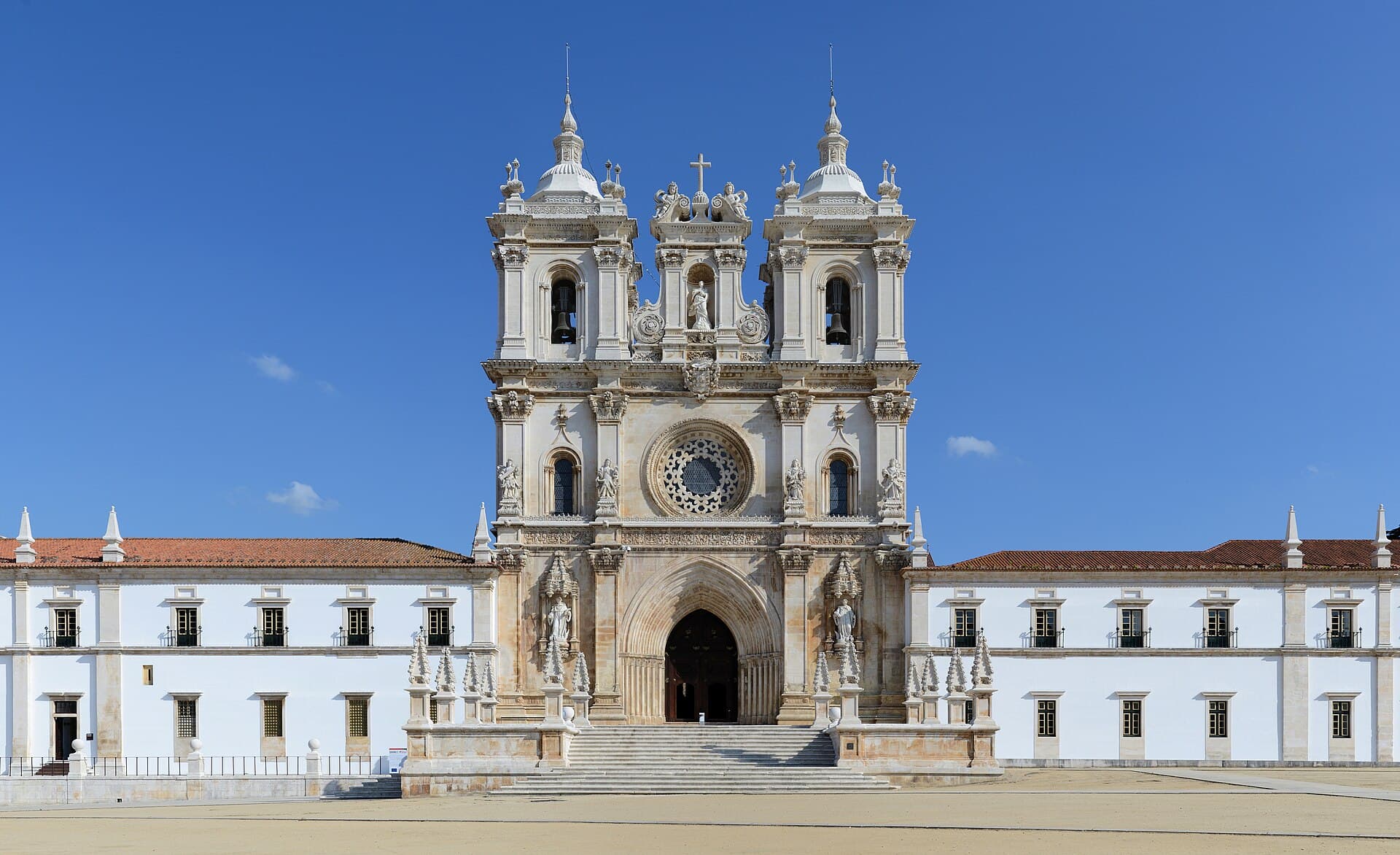 Alvesgaspar / CC BY-SA 4.0, via Wikimedia Commons
“Where a king's love defied death, and monks cooked for an army.”
Not the postcards. The stories even locals don't know — whispered in your ear, right where they happened.
The kitchen here is unlike any other you've seen in a monastery.
There's a doorway between the kitchen and the refectory that has a rather curious local legend.
Imagine a room where nearly a thousand monks once slept.
Discover every secret of Alcobaça
Every address, every reveal in full — in your ear, right where it happened.
You pick your stops. You walk. The voice reveals what the others miss.
No tours available yet. Check back soon — we're preparing them.
Alcobaça, a town in west-central Portugal, is defined by the imposing presence of its Cistercian Monastery of Santa Maria. This UNESCO World Heritage site, founded in 1153, stands as a monumental example of early Gothic architecture in Portugal. The monastery's austere yet grand design reflects the Cistercian order's emphasis on simplicity and discipline.
The town itself rests at the confluence of the Alcoa and Baça rivers, which some believe is the origin of its name. Beyond the monastery walls, Alcobaça offers a quieter pace, with inviting streets and local life unfolding around this historic core. It's a place where centuries of history, a legendary love story, and a distinctive architectural style converge, inviting visitors to explore its many layers.
Alcobaça also serves as a convenient base for exploring other significant sites in central Portugal, making it an excellent stop on a wider itinerary through the region.
The story of Alcobaça begins in 1147, when Portugal's first king, Afonso Henriques, conquered Santarém from the Moors. In thanksgiving for this victory, he vowed to build a magnificent home for the Cistercian Order. This act was not merely religious; it was a strategic move to solidify his authority and promote the Christian colonization of newly conquered lands during the Reconquista. Construction of the Mosteiro de Santa Maria de Alcobaça began in 1178, some 25 years after the first Cistercian monks settled in the region.
The monastery's design followed the model of the Abbey of Clairvaux in France, founded by Bernard of Clairvaux. The church was consecrated in 1252, marking it as the first truly Gothic building in Portugal and, at the time, the largest church in the country. True to Cistercian principles, the original monastic buildings were constructed with lean architectonic lines, emphasizing simplicity and functionality with minimal decoration.
Throughout its seven-century history, the Alcobaça Monastery maintained a close association with the Portuguese monarchy, becoming the most prosperous and influential monastery in Portugal by 1300. At its peak, it housed nearly 1,000 monks and held significant business interests in farming, fishing, and trade. The monks also played a crucial role in shaping Portuguese culture, offering public lessons as early as 1269 and producing the first authoritative history of Portugal.
Within the monastery's church lie the tombs of King Pedro I and Inês de Castro, the protagonists of Portugal's most famous and tragic love story. In 1357, upon his coronation, King Pedro I famously exhumed the body of his murdered beloved, dressed her in royal robes, and commanded his court to kiss her hand. Their elaborately carved Gothic tombs are positioned foot-to-foot in the transept, so that on Judgment Day, the first face each will see is the other's.
The monastery's influence waned over time, and it eventually closed in 1834 during the dissolution of monasteries in Portugal. During the Peninsular War in 1810, invading French soldiers desecrated the royal tombs, searching in vain for jewels, and destroyed much of the monastery's extensive library. Despite these losses, the Alcobaça Monastery was designated a UNESCO World Heritage Site in 1989, recognized for its outstanding universal value and architectural significance as a prime example of Gothic architecture in Portugal.
The undisputed highlight of Alcobaça is the Mosteiro de Santa Maria de Alcobaça, a UNESCO World Heritage site. Begin your exploration in the Church, the first Gothic church in Portugal, notable for its soaring, unadorned interior that reflects Cistercian austerity. Here, you'll find the Royal Tombs of King Pedro I and Inês de Castro, masterpieces of Gothic sculpture positioned so they face each other in eternity.
Beyond the main church, venture into the Cloister of Silence (Claustro de Dom Dinis), one of the largest medieval Cistercian cloisters in Europe, known for its serene atmosphere and Gothic arches. The Refectory, where monks took their meals in silence, features a unique pulpit embedded in the wall. Do not overlook the Kitchen, with its colossal central chimney and the ingenious canal that brought fresh water and fish directly into the room. The Room of the Kings is adorned with 18th-century azulejo tile panels depicting the monastery's history and terracotta statues of Portuguese kings.
For sweeping views of the monastery and the town, take a short walk up to the Castle of Alcobaça ruins. While the castle itself is mostly walls and rebuilt towers, the viewpoint offers an excellent perspective. Just beyond the monastery, where the Alcoa and Baça rivers meet, you'll find a public park celebrating the story of Pedro and Inês, complete with stone thrones and a heart sculpture.
The best time to visit Alcobaça is during spring (April to June) or early autumn (September to October). Temperatures are mild (12–24°C), and there is less rainfall. These shoulder seasons also mean fewer crowds compared to the peak summer months of July and August. Summer brings warmer, drier weather, but also more visitors. While winter offers a quieter, more atmospheric experience, the monastery's unheated interior can be cold, and there's a higher chance of rain.
The Alcobaça Monastery is open daily, with hours varying seasonally: 9:00 AM to 6:00 PM from October to March, and 9:00 AM to 7:00 PM from April to September. Last admission is typically 30 minutes before closing. The monastery is closed on January 1st, Easter Sunday, May 1st, August 20th, and December 25th.
Entry to the church, nave, and the tombs of Pedro I and Inês de Castro is free. A ticket for the rest of the monastery, including the cloisters and adjoining rooms, costs €6. A combined ticket for Alcobaça, Batalha Monastery, and the Convent of Christ in Tomar is available for €15. Weekday mornings, especially before 11:00 AM or after 3:00 PM, are generally less crowded.
Alcobaça is about a 90-minute drive north of Lisbon via the A8 motorway. Public buses from Lisbon (Sete Rios station) also run directly to Alcobaça, taking around 1 hour and 40 minutes. The bus station is a short walk from the monastery. Free parking is often available near the town center. The monastery has access ramps to the ground floor for visitors with reduced mobility.