Ajloun Castle
The castle's original designation hints at a strategic purpose beyond mere defense.
Full story unlocks in the tour
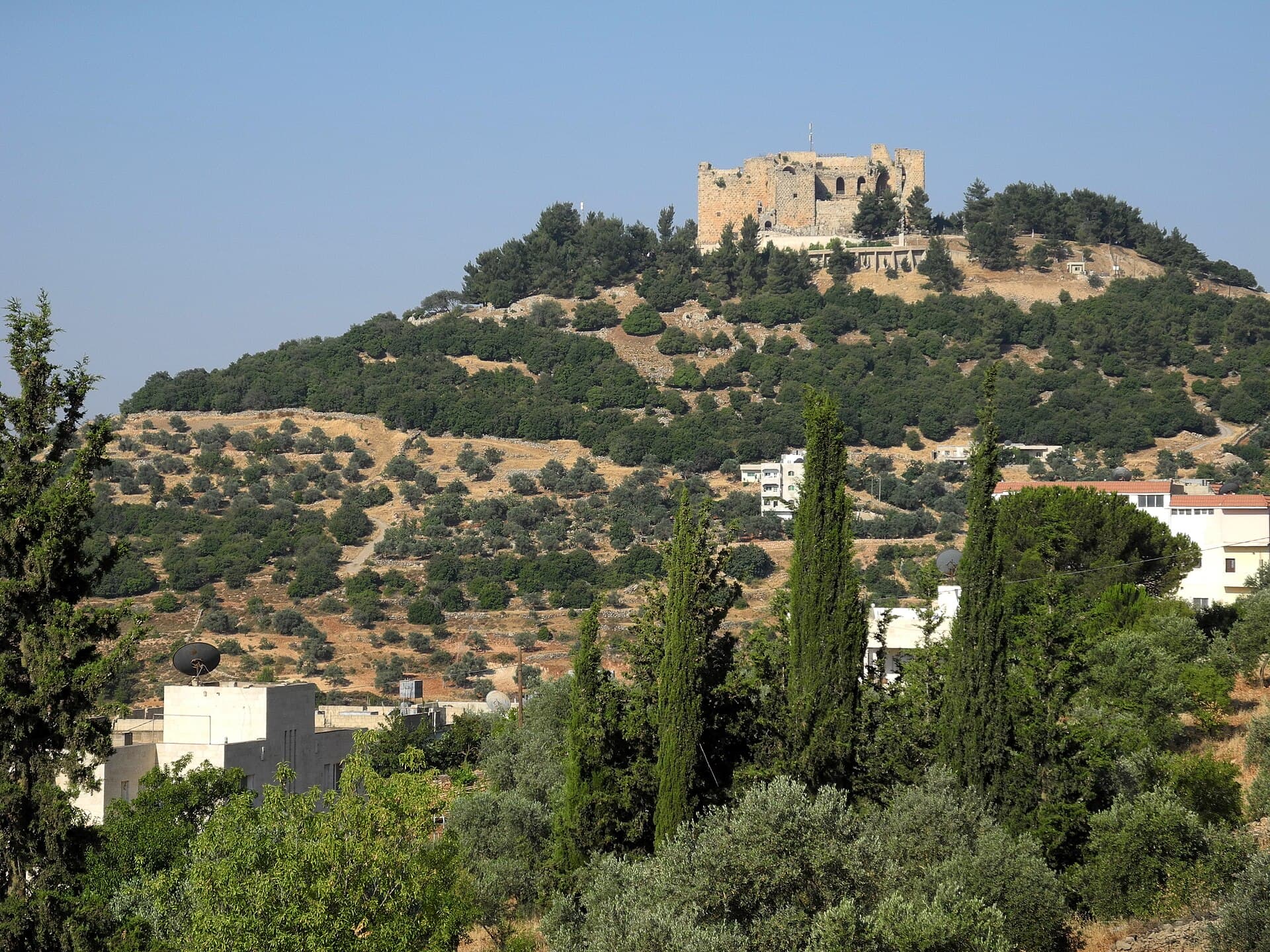 Hiking in Jordan website and guidebook / CC BY-SA 2.0, via Wikimedia Commons
“Where emerald hills embrace Crusader history.”
Not the postcards. The stories even locals don't know — whispered in your ear, right where they happened.
The castle's original designation hints at a strategic purpose beyond mere defense.
This verdant expanse holds a secret, connecting it to ancient times and a surprising modern-day craft.
A quiet hilltop archaeological site bears a profound connection to a revered prophet and a powerful event.
Discover every secret of Ajloun
Every address, every reveal in full — in your ear, right where it happened.
You pick your stops. You walk. The voice reveals what the others miss.
No tours available yet. Check back soon — we're preparing them.
Ajloun, a mountainous region in northwestern Jordan, offers a refreshing contrast to the country's more arid landscapes. Known for its verdant forests, rolling hills, and fertile valleys, it's a destination where history and nature intertwine. The area is dominated by the imposing 12th-century Ajloun Castle, a testament to its strategic importance throughout various historical periods.
Beyond the castle, Ajloun is a haven for outdoor enthusiasts, with the Ajloun Forest Reserve providing extensive hiking trails through oak and pine woodlands. The region also offers a glimpse into authentic Jordanian village life, with opportunities to experience local cuisine, traditional crafts, and warm hospitality. Ajloun provides a quieter, more local travel experience, making it an ideal escape from bustling cities and a perfect addition to any Jordanian itinerary.
## A Fortress Against Crusaders Ajloun's history is largely defined by its strategic location. The most prominent historical landmark, Ajloun Castle (Qal'at ar-Rabad), was commissioned in 1184 by Izz al-Din Usama, a general of Saladin. Its primary purpose was to defend against Crusader incursions from the west and to secure vital trade and pilgrimage routes connecting Damascus and Egypt.
## Shifting Powers and Earthquakes The castle, built on the site of an older Byzantine monastery, was designed as an imposing stronghold with a moat, drawbridge, and towers. It played a crucial role in Saladin's efforts to unite Muslim forces, and its construction predated his decisive victory against the Crusaders at the Battle of Hattin in 1187. In the early 13th century, the castle was enlarged by Aibak ibn Abdullah, the Mamluk governor. However, it faced destruction at the hands of Mongol invaders in 1260 before being reclaimed and rebuilt by the Mamluk Sultan Baibars. Under Mamluk rule, Ajloun Castle served as an important provincial stronghold and administrative base. The Ottomans later garrisoned troops there until the 19th century, when severe damage from earthquakes in 1837 and 1927 led to its abandonment.
## Beyond the Castle Walls While the castle is a focal point, Ajloun's historical narrative extends further. The region has been inhabited since the Roman and Byzantine periods, with archaeological sites like Tell Mar Elias revealing traces of ancient churches and mosaic floors. The Great Ajloun Mosque, dating back around 800 years, stands as one of Jordan's oldest extant mosques, with its current appearance largely influenced by Ottoman expansion. Ajloun's history is a testament to its enduring significance as a crossroads of cultures and a strategic point in the Levant.
Ajloun offers a blend of historical sites and natural beauty. The primary attraction is Ajloun Castle (Qal'at ar-Rabad), a 12th-century Muslim fortress that provides wide views of the Jordan Valley, and on clear days, parts of Syria and Palestine. Explore its stone corridors, towers, and chambers, and visit the small museum inside which displays artifacts like pottery, coins, and weapons.
For nature enthusiasts, the Ajloun Forest Reserve is a compelling visit. This protected area features rolling hills covered in oak, pine, and pistachio trees, offering several hiking trails of varying lengths and difficulties. Popular trails include the Roe Deer Trail, the Soap House Trail (leading to a local soap-making cooperative), and the Orjan Village Trail. The reserve is also ideal for birdwatching and offers eco-lodges for overnight stays.
Another significant site is Tell Mar Elias, believed to be the birthplace of the Prophet Elijah. Here, you can explore the ruins of two 6th-century Byzantine churches with well-preserved mosaic floors. Don't miss the Ajloun Cable Car, which opened in 2023 and connects the town to the castle, offering scenic views over olive groves.
Experience local culture by visiting traditional villages, sampling local cuisine, and exploring handicraft workshops known for olive oil soap and pottery.
The best time to visit Ajloun is during spring (March to May) and autumn (September to November). In spring, the hills are green, and wildflowers are in bloom, with comfortable temperatures ranging from 15°C to 25°C (59-77°F). Autumn offers mild temperatures between 17°C and 28°C (63-82°F) and is the season for the olive harvest, often accompanied by local festivals. While summers (June to August) are warm, Ajloun's higher elevation makes it cooler than other parts of Jordan, with daytime temperatures between 25°C and 32°C (77-90°F). Winters (December to February) are colder and rainy, with occasional snowfall, but offer a peaceful atmosphere.
Ajloun is approximately 76 kilometers (47 miles) northwest of Amman. The easiest way to reach Ajloun from Amman is by car or taxi, taking about 1 to 1.5 hours. JETT buses also operate from Amman to Ajloun once daily on Thursdays and Sundays, with a journey time of around 1 hour 22 minutes and costs between $3 and $22. If combining with Jerash, the drive between the two is about 30 minutes.
Dress modestly, especially when visiting rural areas and religious sites, by covering your shoulders and knees. Comfortable walking shoes are essential for exploring the castle and hiking in the reserve. Carry sufficient water, especially during warmer months, and use sunscreen. The local currency is the Jordanian Dinar (JOD), and it's advisable to carry cash for smaller purchases as card options may be limited. Consider purchasing the Jordan Pass, which often includes entry to Ajloun Castle and can save on visa costs.