The Ksar's Walls
The earthen walls of Aït Benhaddou hold a secret ingredient that makes them both resilient and vulnerable.
Full story unlocks in the tour
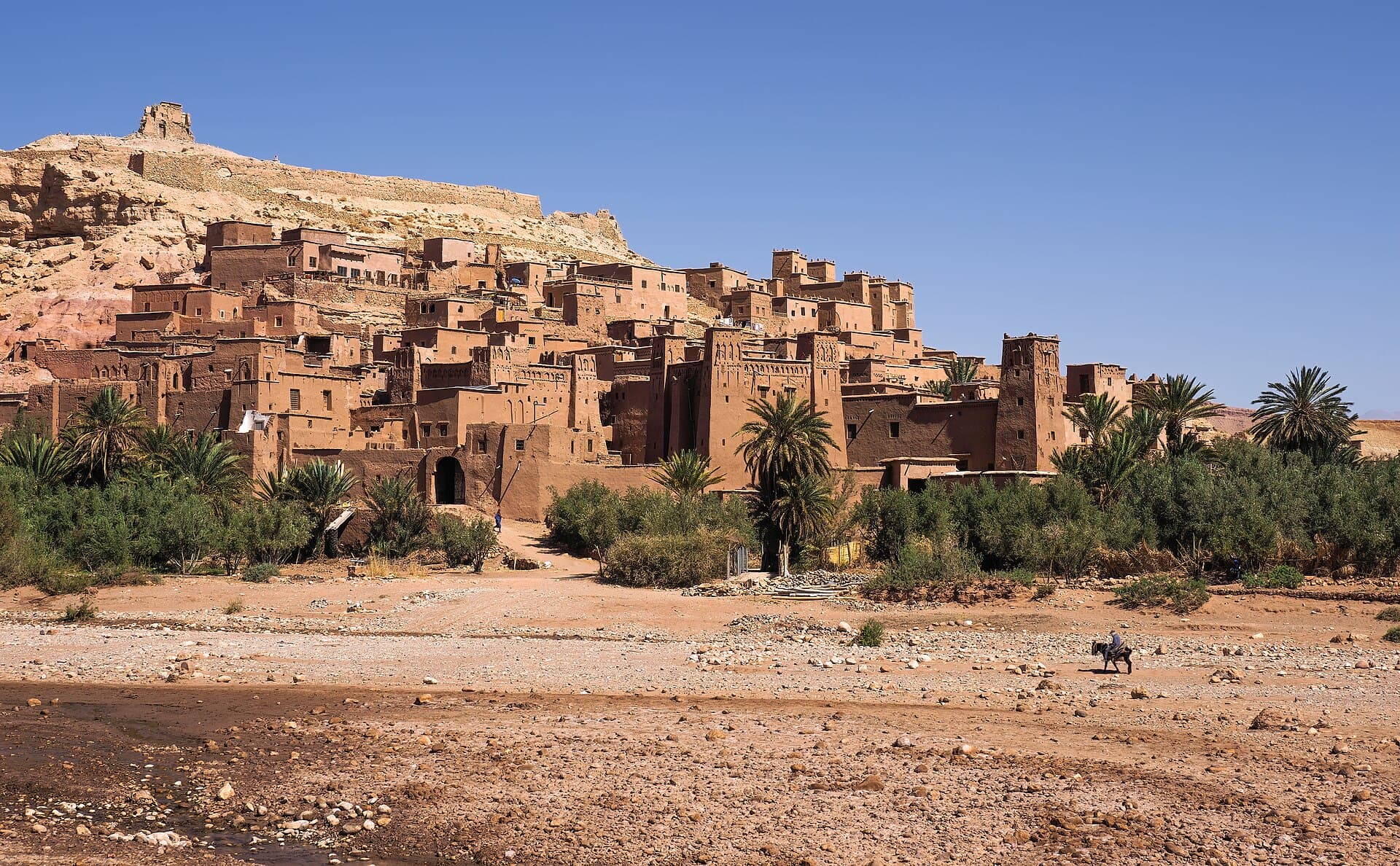 Petar Milošević / CC BY-SA 4.0, via Wikimedia Commons
“Where ancient earth architecture meets cinematic dreams.”
Not the postcards. The stories even locals don't know — whispered in your ear, right where they happened.
The earthen walls of Aït Benhaddou hold a secret ingredient that makes them both resilient and vulnerable.
At the ksar's highest point, beyond the residential areas, stands a structure with a surprising original purpose.
While the ancient ksar endures as a testament to history, the majority of its former inhabitants have quietly relocated just a short distance away.
Discover every secret of Aït Benhaddou
Every address, every reveal in full — in your ear, right where it happened.
You pick your stops. You walk. The voice reveals what the others miss.
No tours available yet. Check back soon — we're preparing them.
Aït Benhaddou, a fortified village (ksar) in southern Morocco, rises from the banks of the Ounila River as a striking example of pre-Saharan earthen architecture. This UNESCO World Heritage Site has captivated travelers and filmmakers alike with its ancient mud-brick structures and labyrinthine alleys. For centuries, it served as a vital stop on the trans-Saharan caravan route, connecting the Sahara to Marrakech, where merchants traded gold, salt, spices, and slaves.
The ksar's distinctive ochre walls, reinforced by corner towers and a baffle gate, house a collection of dwellings ranging from modest homes to multi-story kasbahs, resembling small urban castles. Its timeless beauty has made it a celebrated film location, providing the backdrop for numerous international productions, including Lawrence of Arabia, Gladiator, and Game of Thrones. A visit here offers a glimpse into a traditional way of life, with a few families still inhabiting the ancient structures, maintaining their customs amidst the enduring earthen architecture.
While the ksar is a living village, open to explore at any time, the most rewarding experience often comes from slowing down to appreciate its intricate details, from the geometric motifs adorning its upper sections to the expansive views from its highest points. It's a place where every wall seems to carry traces of a story stretching back nearly a thousand years, inviting visitors to connect deeply with Morocco's cultural and architectural heritage.
The history of Aït Benhaddou stretches back to at least the 11th century, during the Almoravid dynasty, when the site was first fortified. Its strategic location in the Ounila Valley, along one of the main trans-Saharan trade routes, made it a crucial stopping point for caravans traversing between the Sahara and Marrakech. This route, which included the Tizi n'Tichka pass, was one of the few ways to cross the Atlas Mountains. The wealth generated from tolls and trade in goods like gold, salt, and spices fueled the development of the ksar, leading to the construction of its multi-story kasbahs, a mosque, a caravanserai, and a communal granary.
While the site has been fortified since the 11th century, most of the current buildings and the maze-like streets date from the 17th century. Aït Benhaddou is a prime example of southern Moroccan earthen architecture, with structures built entirely from local materials such as rammed earth (pisé), adobe, clay bricks, and wood. This traditional building technique, while cost-effective, requires constant maintenance due to the materials' vulnerability to erosion from rain. The ksar's distinctive red clay glows with the changing light, and its walls often feature geometric patterns with cultural and religious significance.
By the early 2000s, Aït Benhaddou faced near-total abandonment, prompting the World Heritage Committee to consider placing it on the Danger List. However, its recognition as a UNESCO World Heritage Site in 1987, alongside its growing fame as a film location, brought renewed attention and efforts towards its preservation. This designation acknowledged its significance as an outstanding example of earthen construction and a traditional way of life under threat. Restoration efforts, particularly between 2007 and 2012, have focused on using traditional materials and techniques to maintain the site's historical authenticity.
The 20th century saw a decline in the ksar's strategic importance as modern transportation replaced caravan routes, leading many residents to relocate to a newer village across the Ounila River. Today, only a few families continue to live within the ancient ksar, preserving a traditional way of life. Tourism and agriculture now form the backbone of the local economy. The ksar's enduring appeal lies in its ability to transport visitors back in time, offering a tangible connection to Morocco's past and its resilient Berber heritage.
Begin your exploration by wandering through the narrow, winding alleys of the ksar, where you can admire the intricate earthen architecture up close. Many residents have opened their homes as small private museums, offering a glimpse into traditional interiors for a small donation. Climb to the remains of the fortified granary (agadir) at the top of the hill for expansive panoramic views of the ksar, the Ounila Valley, and the surrounding High Atlas Mountains.
Take time to visit the House of Oral Tradition (Maison de l'Oralité), a cultural center dedicated to preserving Amazigh oral heritage, which also features a Berber carpet exhibition. You might also find local artists' workshops and small shops selling Moroccan handicrafts, including Amazigh rugs and jewelry. For a different perspective, stroll along the riverbed or cross the pedestrian bridge to the modern village, offering unique angles for photography, especially during sunrise or sunset when the ksar glows golden. Consider enjoying a meal or a mint tea at one of the riverside restaurants for a final view of the ancient settlement.
The ideal time to visit Aït Benhaddou is during the shoulder seasons: March to May and October to November. During these months, temperatures are mild and skies are clear, providing comfortable conditions for exploring the ksar and its surroundings. Early mornings or late afternoons are particularly recommended to avoid midday heat and to experience the soft, golden light that enhances the earthen architecture. While summer brings intense sun, it also offers cultural festivities, though early visits are crucial to avoid the heat. Winter offers quiet solitude and the rare sight of snow-capped Atlas Mountains, though visitors should dress warmly for colder mornings and nights.
Aït Benhaddou is approximately 30 kilometers from Ouarzazate and about 180-190 kilometers from Marrakech. The drive from Ouarzazate takes about 40 minutes, while from Marrakech, it's roughly 3.5 to 4 hours, often crossing the Tizi n'Tichka Pass. While public transport options are limited, shared taxis from Ouarzazate or organized tours from Marrakech are common. There is no official entrance fee to the ksar, as it is a living village, but some residents may request a small donation to enter their homes or private museums. Expect to spend 1 to 3 hours exploring the ksar, including the climb to the granary. Comfortable footwear is advised due to the uneven terrain and steps. Modest dress is recommended out of respect for local culture. Cash (Moroccan Dirham) is essential, as there are no ATMs within the village.