Plaza de las Tres Centurias
This park serves as a monument to Mexico's railway history, yet it's also a place where the passage of time seems to ripple.
Full story unlocks in the tour
 Comisión Mexicana de Filmaciones from México D. F., México / CC BY-SA 2.0, via Wikimedia Commons
“Where thermal springs meet a lively culture and a playful take on mortality.”
Not the postcards. The stories even locals don't know — whispered in your ear, right where they happened.
This park serves as a monument to Mexico's railway history, yet it's also a place where the passage of time seems to ripple.
A museum dedicated to death might suggest a somber experience, but here, it offers anything but.
This annual fair draws millions, transforming the city, yet its beginnings were far more modest than one might imagine.
Discover every secret of Aguascalientes
Every address, every reveal in full — in your ear, right where it happened.
You pick your stops. You walk. The voice reveals what the others miss.
No tours available yet. Check back soon — we're preparing them.
Aguascalientes, a name meaning "hot waters" in Spanish, is a city in central Mexico, christened for the thermal springs that first drew settlers. Though one of Mexico's smaller states, it maintains a significant standing due to its strategic location and lively culture. The city is often referred to as "the land of the good people" because of its welcoming inhabitants. Aguascalientes offers a blend of colonial architecture, animated festivals, and distinctive museums, providing a deep exploration into Mexican culture.
Beyond its widely recognized annual fair, the Feria Nacional de San Marcos, Aguascalientes presents a walkable and secure environment for discovery. Visitors can explore historic parks, diverse cuisine, and opportunities for eco-tourism in the surrounding areas. From its historic city center, adorned with Baroque churches and elegant plazas, to its role as a pivotal railway hub, Aguascalientes offers a rich journey.
The territory now recognized as Aguascalientes was originally part of "La Gran Chichimeca," inhabited by various nomadic indigenous tribes, including the Caxcán, Zacatecos, and Guachichile peoples, who maintained their independence from Aztec rule. The discovery of silver in Zacatecas in 1546 led to an increased Spanish presence and the Chichimeca War (1550-1590), a prolonged conflict as indigenous communities resisted Spanish encroachment.
The city of Aguascalientes was established on October 22, 1575, by Juan de Montoro and his family. It was initially conceived as a military outpost and a stopping point along the merchant route between Zacatecas and Mexico City, safeguarding silver shipments from the Chichimeca. The settlement was named Villa de Nuestra Señora de la Asunción de las Aguas Calientes, referencing its patron saint and the many thermal springs. By 1582, the settlement's population had diminished to a military commander, 16 soldiers, and two citizens due to the ongoing Chichimeca War. A new wave of Spanish settlers, alongside indigenous and Black enslaved people, arrived in the late 1590s to develop the area.
Aguascalientes experienced frequent jurisdictional disputes with neighboring Jalisco and Zacatecas during both colonial times and after independence. In 1804, it became a sub-delegation of Zacatecas. After the Mexican War of Independence, Aguascalientes briefly achieved independent political status in 1821, but was reincorporated into Zacatecas in 1824. In 1835, President Antonio López de Santa Anna declared Aguascalientes a new territory, separating it from Zacatecas as a political consequence. It finally attained the status of a Free and Sovereign State of Aguascalientes on February 5, 1857.
During the Porfiriato era, Aguascalientes evolved into a primary railway hub, hosting the main workshops of the Mexican Central Railway company, which spurred industrial and cultural advancement. The city also hosted the Revolutionary Convention of 1914, a significant assembly of war generals during the Mexican Revolution. Today, Aguascalientes is recognized for its textile, electronics, and auto parts industries, playing an integral role in Mexico's economy.
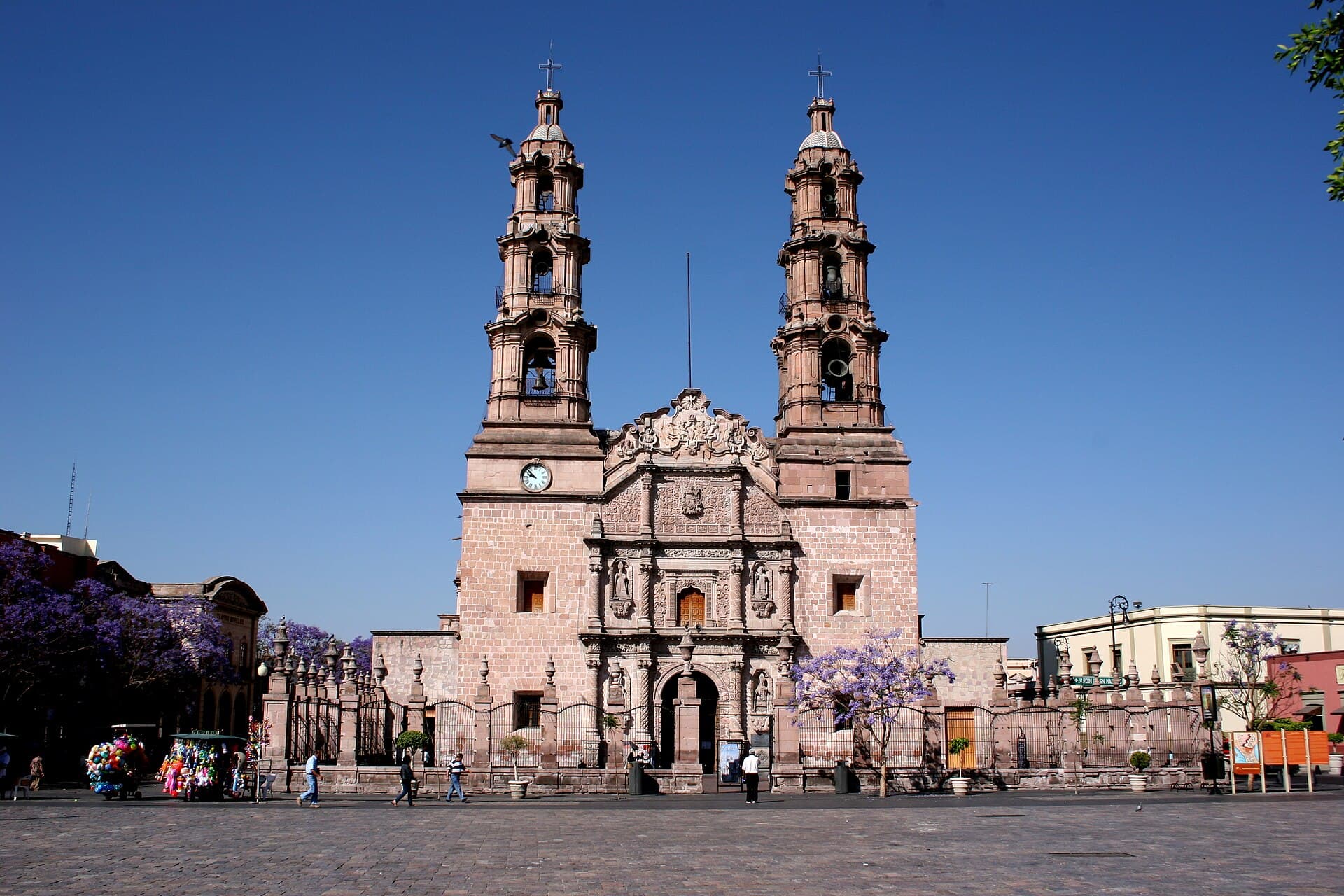
The historic center of Aguascalientes offers a good starting point, with its colonial architecture, plazas, and the Cathedral Basilica of Our Lady of the Assumption, dating back to 1704. The Palacio de Gobierno is also noteworthy for its murals depicting the city's narrative.
A brief walk from the center leads to the Barrio del Encino, a relaxed neighborhood predating Aguascalientes proper, featuring the Baroque-style Templo del Señor del Encino and the José Guadalupe Posada Museum. This museum honors José Guadalupe Posada, the artist behind the iconic La Catrina, a symbol of the Day of the Dead. Fittingly, the Museo Nacional de la Muerte (National Museum of Death) is also nearby, exploring Mexico's distinctive relationship with mortality through an expansive collection of artifacts.
For a glimpse into the city's industrial past, consider the Plaza de las Tres Centurias (Three Centuries Park), a historic railway complex with a museum, old locomotives, and dancing fountains. The park also includes a children's train and a monumental clock. Outside the city, the Ojocaliente Hot Springs provide an opportunity to unwind in the thermal waters that gave the city its name.
The most favorable time to visit Aguascalientes for general outdoor pursuits is from early May to mid-June, with a peak in the last week of May, when the weather is warm and clear. The dry season in Aguascalientes typically extends from October to May, bringing minimal rainfall and abundant sunny days. Temperatures during this period are comfortable, ranging from 21-27°C during the day. The warmest months are April and May, with daytime highs reaching 28-30°C. The city comes alive during the Feria Nacional de San Marcos, which usually spans three to four weeks between April and May.
Aguascalientes is considered one of Mexico's safer cities, with a visible police presence, particularly in central areas. While generally secure, it is always prudent to observe basic precautions, such as being mindful of pickpockets in crowded spaces, especially during large festivals.
The city center is compact and easily explored on foot. For getting around, public buses are available, and taxis or ride-sharing applications can be utilized. Aguascalientes has an international airport about a 45-minute drive from the city center, offering flights from various locations in Mexico and the USA. Renting a car can provide greater flexibility for exploring the surrounding region. Accommodation options range from historic hacienda hotels to modern establishments, often at more accessible prices than other Mexican cities.