Jomfru Ane Gade
This spirited street, famed for its evening revelry, carries a surprising, almost cloistered, origin in its very name.
Full story unlocks in the tour
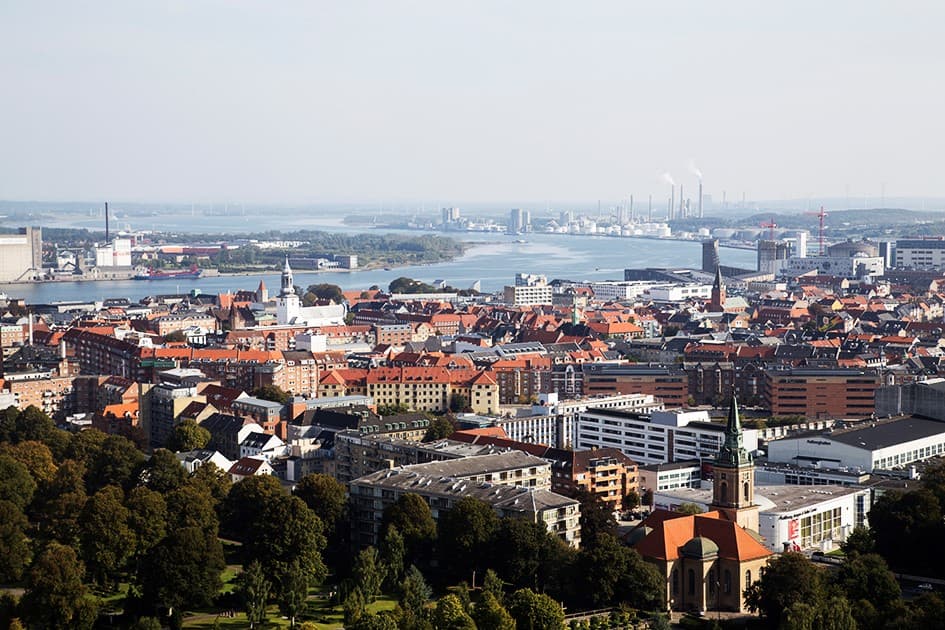 ClausFalk / CC BY-SA 4.0, via Wikimedia Commons
“Where the echoes of Viking sagas meet the cool pulse of Nordic innovation.”
Not the postcards. The stories even locals don't know — whispered in your ear, right where they happened.
This spirited street, famed for its evening revelry, carries a surprising, almost cloistered, origin in its very name.
This half-timbered castle, constructed as a stronghold, proved remarkably unsuited for its initial defensive purpose.
The culminating architectural work of Jørn Utzon, the celebrated architect behind the Sydney Opera House, this center functions beyond the scope of a traditional museum.
Discover every secret of Aalborg
Every address, every reveal in full — in your ear, right where it happened.
You pick your stops. You walk. The voice reveals what the others miss.
No tours available yet. Check back soon — we're preparing them.
Aalborg, Denmark's fourth-largest city, offers a compelling fusion of ancient narratives and contemporary ingenuity. Positioned at the narrowest point of the Limfjord, the city has served as a significant trading post for over a millennium, with its origins reaching back to Viking settlements around 700 AD. Today, Aalborg has shed its industrial past, transforming into a lively cultural and educational center.
Stroll along the revitalized waterfront, where modern architectural wonders like the Utzon Center and Musikkens Hus stand alongside historic brick warehouses, reflecting the city's continuous evolution. Beyond its architectural contours, Aalborg is recognized for its extensive street art, inviting shopping streets, and an animated atmosphere that has contributed to its residents being acknowledged as some of the most contented in Europe.
From ancient burial grounds to a flourishing student community, Aalborg invites thorough exploration, revealing layers of history and a forward-looking spirit. It is a city that rewards unhurried travel, offering a relaxed pace to uncover its distinct character, whether enjoying coffee by the fjord or wandering through its colorful historic lanes.
Aalborg's narrative commences over a millennium ago, with settlements dating to the Iron Age and a thriving Viking community around 700 AD. Its strategic placement at the narrowest point of the Limfjord established it as an important harbor and trading post, with the name "Alabu" appearing on coins as early as 1040. By 1342, Aalborg received city rights, and throughout the Middle Ages, it prospered through commerce and a flourishing herring fishery in the Limfjord. This period saw the establishment of significant landmarks, including Budolfi Church by 1500 and Aalborghus Castle in 1550, solidifying its status as a northern bastion.
The 16th and 17th centuries marked a period of considerable affluence for Aalborg's merchants, who profited from grain and livestock exports, making it Denmark's second-largest city by the late 1600s. However, the 18th century brought difficulties with the decline of the herring trade and political shifts.
The 19th century introduced a new era of industrialization. The completion of a pontoon bridge in 1865 and the arrival of the railway in 1869 connected Aalborg to national and international trade networks, stimulating economic expansion. Aalborg became a significant producer of tobacco products, spirits, fertilizers, and cement, earning it the designation "the city of smoking chimneys" by 1960, with nearly half its population employed in industry.
The late 20th century witnessed another transformation. As traditional industries diminished in the 1970s, Aalborg pivoted towards a knowledge-based economy, marked by the founding of Aalborg University in 1974. Today, the city is a lively student destination, celebrated for its culture, contemporary architecture, and a strong emphasis on high-tech industries like wind turbine manufacturing.
Begin your journey along Aalborg's revitalized waterfront, where contemporary architecture meets enduring character. The Utzon Center, conceived by Jørn Utzon of Sydney Opera House renown, is a striking architectural center for design and concepts, distinct from a conventional museum. Nearby, the House of Music (Musikkens Hus), with its silver-toned exterior, hosts the Aalborg Symphony Orchestra. You can also observe student housing in repurposed silos along the water.
Step into the past by wandering through the cobbled passages of the historic core. Budolfi Cathedral, a 14th-century white-stucco church, stands as a central point of reference. Do not overlook Jens Bang's Stone House (Jens Bang's Stenhus), a lavish Renaissance merchant's dwelling from 1624, considered one of Denmark's most beautiful Renaissance structures. Aalborghus Castle, a 16th-century half-timbered fortress, provides a glimpse into royal history, with its park accessible year-round and dungeons open during summer months.
For a deeper immersion into history, visit the Lindholm Høje Viking Museum just north of the city, an Iron Age and Viking burial ground with 682 stone graves. Alternatively, descend to the Gråbrødrekloster Museum, an underground museum constructed around medieval monastery ruins. Aalborg is also a canvas for street art, with over 50 large-scale murals adorning building facades throughout the city center.
The most favorable time to visit Aalborg for warm-weather activities extends from late June to late August, when average daily temperatures exceed 17°C (63°F) and highs can reach 20°C (69°F). This period offers comfortable conditions for outdoor exploration and numerous festivals. Spring (April-May) and autumn (September-October) provide moderate temperatures and fewer visitors. While winters are cool, with temperatures just above freezing, the city adopts a cozy Christmas ambiance from late November. The Aalborg Carnival, one of Scandinavia's largest festivals, occurs in May.
Aalborg is a very walkable city, allowing for easy exploration of its attractions on foot. The city center is compact, with pedestrian thoroughfares like Bispensgade, Algade, and Gravensgade offering a mix of larger retail chains and independent boutiques. Public transportation is readily available for venturing further afield. Taxis are an option, but can be costly. The local currency is the Danish Krone (DKK). English is widely spoken, particularly within the tourism sector and among younger generations. Denmark's weather can be variable, so it is wise to pack layers and rain gear, even during summer.